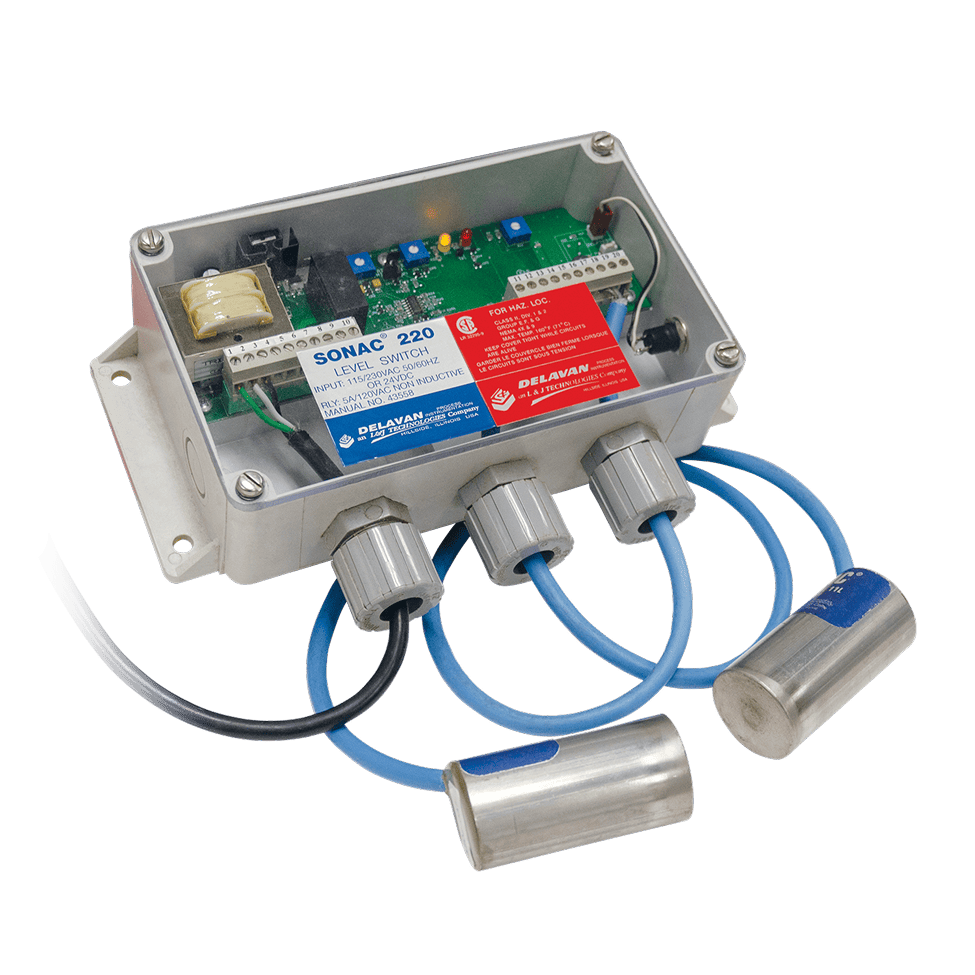
SONAC 220
01

Ultrasonic Point Level Switches

SONAC 220
Reliable point-level detection for bulk solids.

What It Is & How It Works

An ultrasonic level switch detects the presence or absence of material at a fixed point using high-frequency acoustic energy. A matched pair of ultrasonic transducers, a transmitter and a receiver, are mounted facing each other across an air gap or vessel opening. The transmitter continuously emits sound pulses; when bulk material enters the sensing zone between the two sensors, it interrupts the acoustic path and the receiver detects the signal drop. This change triggers a relay to actuate an alarm, pump control, or shutdown action.

Because ultrasonic switches operate through an air gap rather than by contacting the product, they avoid the wear, fouling, and contamination that degrade mechanical probes in abrasive or sticky materials. The paired transducers continuously monitor the path between them, adjusting automatically for temperature and humidity changes. When material interrupts the beam, the signal loss actuates a relay output with selectable fail-safe logic and adjustable time delays ranging from 50 milliseconds to 30 seconds, filtering nuisance trips from dust clouds, conveyor vibration, or intermittent material flow.

Installation is straightforward: mount the transmitter and receiver on opposite sides of the bin, hopper, or chute at the desired alarm point, align the sensors, and wire to the control system. Most ultrasonic switches require no field calibration and can be configured on site in minutes. Sensing distances range up to 12 feet between transducers, accommodating a wide variety of vessel geometries.

One selection factor newcomers should understand: ultrasonic switches are optimized for dry bulk solids, powders, and granular materials. Heavy slurries, high-viscosity liquids, and very dense or compacted materials can attenuate the acoustic signal beyond the reliable sensing range. For liquid-only applications, a magnetostrictive switch offers a more robust detection principle.

Ultrasonic Switch vs. Microwave Switch

Both the Sonac 220 and Microwave 320 provide non-intrusive point level detection without contacting the product. The Sonac 220 uses paired ultrasonic transducers across an air gap, suited for standard bulk solids below 400 °F. The Microwave 320 transmits pulsed microwave energy through sealed vessel walls or non-metallic windows, handling temperatures up to 750 °F and aggressive environments that would damage ultrasonic sensor housings.

Choose microwave switches for extreme heat, sealed vessels, or corrosive products.

Choose ultrasonic for routine solids detection.

When to Choose an Ultrasonic Switch

Ultrasonic switches are the right choice when you need non-contact, through-air detection in dry bulk solids, powders, or granular materials:

  • Bulk Powder Storage Bins & Hoppers High- or low-level alarms in silos, bins, and hoppers storing plastics, wood chips, cereal grains, cement, or other dry bulk materials where mechanical probes foul or wear.
  • Plugged-Chute & Conveyor Detection Detecting blockages in gravity chutes, feeders, and pneumatic conveying lines before they cause equipment damage or production stoppages.
  • Food, Pharmaceutical & Sanitary Packaging Lines Non-contact detection that avoids product contamination, with optional 304 stainless-steel couplings for hygienic installations.
  • Cement, Aggregate & Recycling Systems Reliable detection in dusty, abrasive, and vibrating environments where mechanical switches degrade rapidly and require frequent replacement.
  • Light, Fragile, or Aerated Materials Gentle detection of low-density materials as light as ¼ lb/ft³, including flakes, pellets, and aerated powders, without product damage or compaction.
SONAC 220
SONAC 220 Ultrasonic Level Switch
02

Why It Excels

01

Abrasive, Dusty, or Coating-Prone Materials

No sensor contacts the product, so there is nothing to wear, foul, or coat, maintaining long-term reliability in environments that consume mechanical switches.

02

Low-Density or Fragile Products

Detects materials as light as ¼ lb/ft³ without compacting, breaking, or displacing fragile powders, flakes, or granules.

03

Environments with Heavy Dust, Vibration, or Temperature Swings

Automatic frequency compensation adjusts for temperature and humidity changes, delivering stable detection in process conditions that vary throughout the day or season.

04

Applications Requiring Fail-Safe Self-Verification

Internal self-test on every cycle verifies sensor and electronics health, forcing the relay to a predetermined safe state on any detected fault.

05

Vessels or Chutes Where Probe Intrusion Is Not Practical

Air-gap sensing between external transducers requires no probe penetration into the product stream, eliminating contamination risk and mechanical interference.

06

Facilities Requiring Simple Installation and Minimal Maintenance

No calibration drift, no moving parts, and no product-specific adjustments. Mount, align, wire, and the switch is operational with minimal ongoing service.

03

Choosing the Right Switch Technology

Attribute Sonac 110 Magnetostrictive Sonac 220 Ultrasonic Microwave 320 Microwave
Detection Principle
Vibration damping of a resonant diaphragm Ultrasonic acoustic feedback between matched Tx/Rx sensors Pulsed X-band microwave barrier between Tx/Rx pair
Contact Type
Contact (minimal probe tip intrusion) Non-intrusive (sensors face each other across air gap) Non-contact (installs behind non-metallic windows or across gap)
Primary Media
Liquids only (crude, refined products, solvents, water, chemicals) Solids, granular materials, powders, fragile products (≥¼ lb/ft³) Liquids or solids through non-metallic windows; requires window for metal tanks
Pressure Rating
Up to 2,000 psig Not pressure-rated (ambient/air-gap use) Window/weldment dependent; microwave head is not pressure-rated
Process Temperature
−40 to 220 °F Up to 400 °F (Ryton sensor) Up to 750 °F with high-temp weldments
Fail-safe capability
Self-testing circuit forces relay to safe state on fault Internal self-test verifies on every cycle Selectable fail-safe (high/low)
Not Recommended For
Solids, powders, aerated slurries Heavy slurries or high-viscosity liquids Direct immersion in liquids
Quick Pick
Choose the Sonac 110 for liquid level alarms where pressure tolerance, self-diagnostics, and dielectric-independent detection matter. Choose the Sonac 220 for bulk solids, powders, and fragile materials where non-intrusive, through-air detection below 400 °F is sufficient. Choose the Microwave 320 for extreme temperatures, aggressive products, or applications requiring completely non-contact detection through tank walls or windows.

What to Consider Alongside Ultrasonic Switches

Consider an alternative when:

How this technology fits into a larger system

Ultrasonic switches typically serve as safety, alarm, or automation layers alongside continuous measurement devices and control systems.

  • Continuous measurement plus independent alarm layer. Pair with Radar, Servo, or Magnetostrictive Level Gauges as the continuous measurement device on the same vessel, with the Sonac 220 providing an independent high or low alarm trip for overfill prevention or empty detection. See Radar Level Gauges, Servo Level Gauges, or Magnetostrictive Level Gauges.
  • Complementary switch at a different detection point. Use alongside Sonac 110 Magnetostrictive Switches on the same process where one location handles liquids and another handles dry solids, providing consistent alarm architecture across mixed-media systems. See Magnetostrictive Level Switches.
  • Centralized alarm management across the facility. Connect relay output to Varec FuelsManager® or your SCADA system for real-time alarm status, automated compliance logging, and consolidated alarm handling across multiple bins, hoppers, and vessels. See FuelsManager®.
04

Featured Product

01

Sonac 220 — Ultrasonic Level Switch

Non-intrusive ultrasonic point level detection for solids, powders, and granular materials for gaps up to 12 ft and temperatures up to 400 °F.

Bottom section image
Measure.
Monitor.
Protect.