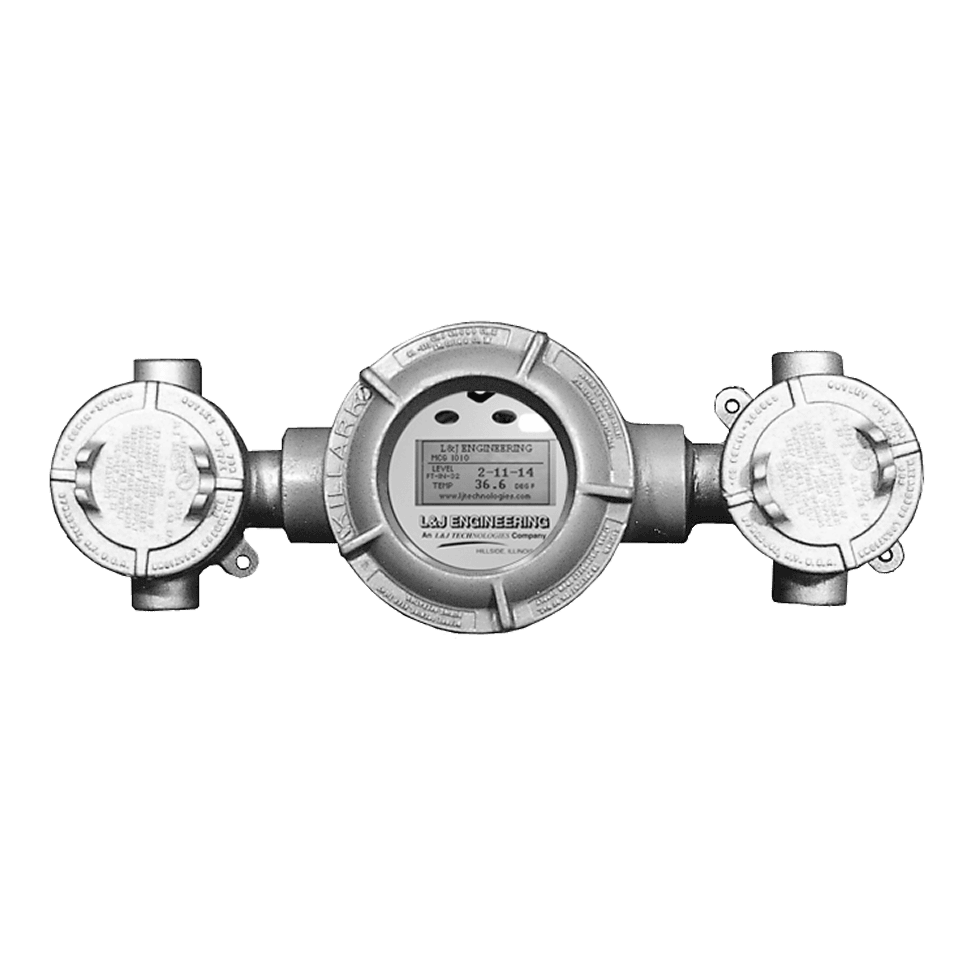
A magnetostrictive level gauge uses a sealed stainless-steel probe inserted vertically into a tank, with one or two magnetic floats riding on the liquid surface. The transmitter sends a brief electrical pulse down a waveguide wire inside the probe. Where the pulse encounters a float’s magnetic field, it generates a torsional wave that travels back to the electronics. By timing that return signal with microsecond resolution, the system determines the exact float position and reports continuous level data with typical accuracy of ±0.001 inches.
Because the measurement is based on time-of-flight along a fixed waveguide, magnetostrictive gauges deliver exceptional long-term stability with no recalibration drift. They are unaffected by changes in dielectric constant, density, or vapor conditions. A second float can simultaneously track a product/water interface, and integrated RTD elements report temperature at multiple heights along the probe, delivering level, interface, and temperature data from a single instrument.
The probe mounts vertically through a tank nozzle or inside a stilling well. A single float measures product level; adding a second float enables simultaneous interface or water content detection. Each float is weighted to match the product it tracks, ensuring it rides at the correct position on the liquid surface. Floats are available in multiple pressure ratings to suit both atmospheric and pressurized tank applications. Proper vertical alignment and clearance inside the riser ensure free float travel across the full measurement range.
Both technologies provide high-accuracy continuous level measurement, but they serve different tank environments. Servo gauges use a wire-suspended displacer to measure level, density, and temperature on large above-ground tanks, with custody-transfer-grade density profiling for fiscal measurement. Magnetostrictive gauges use a sealed probe with magnetic floats, excelling in underground, pressurized, or confined installations where a sealed, no-moving-parts design is essential. Servo measures density directly; magnetostrictive detects liquid interfaces.
Choose servo level gagues for fiscal measurement on above-ground tanks where you need density and/or BS&W measurement.
Choose magnetostrictive level gauges for sealed-probe precision in pressurized and underground installations.
Magnetostrictive gauges are the right choice when sealed-probe construction, long-term measurement stability, and simultaneous level and interface detection are priorities.
Sealed probe design with no external moving parts operates safely in buried, high-pressure, or access-limited tanks.
Dual-float configuration reports product level and water bottom from one probe, eliminating the need for separate instruments.
Time-of-flight measurement is independent of dielectric constant, density, and vapor composition, maintaining accuracy across product changes.
Absolute position measurement along a fixed waveguide does not drift over time, reducing maintenance and recalibration burden.
Built-in RTD elements along the probe length report temperature at multiple heights for stratification monitoring and volume correction.
Consider an alternative when:
Rigid stainless-steel probe for product level, water interface, and temperature profiling in standard tank risers and stilling wells.
Flexible probe for tall or underground tanks where rigid installation is impractical, delivering the same measurement accuracy.
Transmitter/receiver unit that powers both the 8150B and 8151 probes with hazardous area approvals and multiple communication protocols.