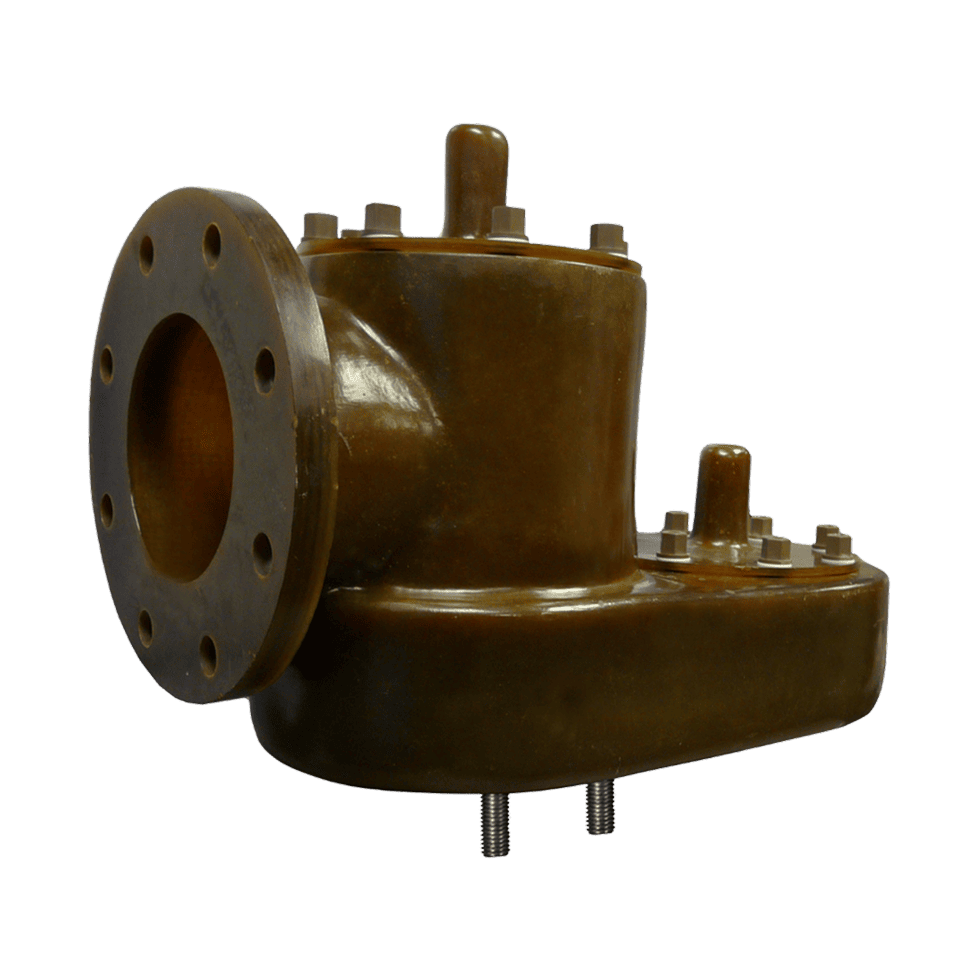
FRP vents and hatches are fiberglass-reinforced polymer (FRP) tank fittings that provide pressure/vacuum breathing and personnel access on tanks storing highly corrosive liquids. They address the fundamental problem that metallic vents and hatches corrode and fail in concentrated acid, caustic, bleach, and brine service, creating both safety and emissions risks when sealing surfaces degrade.
FRP pressure/vacuum vents operate on the same pallet-and-seat principle as metallic conservation vents, opening at defined pressure and vacuum setpoints to relieve tank breathing while controlling emissions. The difference is material: FRP construction resists the chemical attack that destroys carbon steel and stainless steel in aggressive vapor environments. FRP gauge hatches and manway covers provide gas-tight inspection and personnel access using corrosion-resistant sealing surfaces that maintain integrity over years of chemical exposure.
FRP vents and hatches mount to standard FRP or lined-steel tank nozzles. Selection depends on the stored chemical, its vapor composition, the required breathing rate, and the tank design pressure. Where the stored product would corrode metallic alternatives within months, FRP devices provide service lives measured in years without seal degradation or setpoint drift.
Metallic conservation vents (carbon steel, aluminum, stainless steel) serve the majority of petroleum and chemical storage applications where vapor corrosivity is manageable. FRP vents are specified when the vapor environment would corrode metallic alternatives, typically concentrated acids (sulfuric, hydrochloric, phosphoric), caustics (sodium hydroxide), bleach (sodium hypochlorite), and aggressive brine solutions. The choice is driven by chemical compatibility, not by pressure or breathing performance. Same function, different material.
FRP vents and hatches are specified when the stored product’s vapor environment would corrode metallic tank fittings:
FRP construction resists the chemical attack that destroys carbon steel, aluminum, and stainless steel vent components in aggressive vapor service, providing service lives measured in years rather than months.
Replacing a corroded metallic vent requires taking the tank out of service, draining or purging the vapor space, and installing a new device. FRP vents eliminate this cycle by matching their service life to the tank itself.
Corroded metallic pallet and seat surfaces cause setpoint drift, allowing the vent to open early or leak continuously. FRP sealing surfaces maintain their dimensional accuracy and surface finish throughout the device’s service life.
Degraded metallic vent seals are a common source of fugitive emissions in chemical storage. FRP devices maintain seal integrity, supporting compliance with EPA 40 CFR 60/63 and state air quality regulations.
Installing a metallic vent on an FRP tank creates a corrosion-vulnerable point at the top of an otherwise corrosion-proof vessel. FRP vents and hatches match the tank’s material capability from nozzle to pallet.
| Attribute | FRP Pressure/Vacuum Vents | FRP Gauge Hatches & Manway Covers | |
|---|---|---|---|
|
Primary Function
|
Pressure and vacuum breathing control with emissions containment | Gas-tight inspection and personnel access to the tank interior | |
|
Operating Mode
|
Opens automatically at defined pressure/vacuum setpoints | Opened manually by operator for gauging, sampling, or entry | |
|
Normal-condition State
|
Sealed; opens only when setpoint is reached | Sealed; remains closed until operator access is required | |
|
Sizing Basis
|
Breathing rate per API 2000 and tank filling/emptying operations | Standard gauging or personnel access dimensions | |
|
Regulatory Driver
|
EPA 40 CFR 60/63 emissions control, API 2000 | API 653 inspection access, OSHA confined space entry | |
|
Sealing Technology
|
FRP pallet and seat with corrosion-resistant sealing surface | FRP cover with corrosion-resistant gasket or bolted closure | |
|
Recommendation
|
|
|
Fiberglass-reinforced conservation vent for corrosive vapor service, providing controlled tank breathing at defined setpoints on acid, caustic, and bleach storage tanks.
FRP gauge hatch providing corrosion-resistant inspection and gauging access on tanks where metallic hatches would fail in aggressive chemical vapor environments.
FRP manway cover for personnel access to corrosive-service tank interiors, maintaining gas-tight seal integrity across years of chemical exposure.