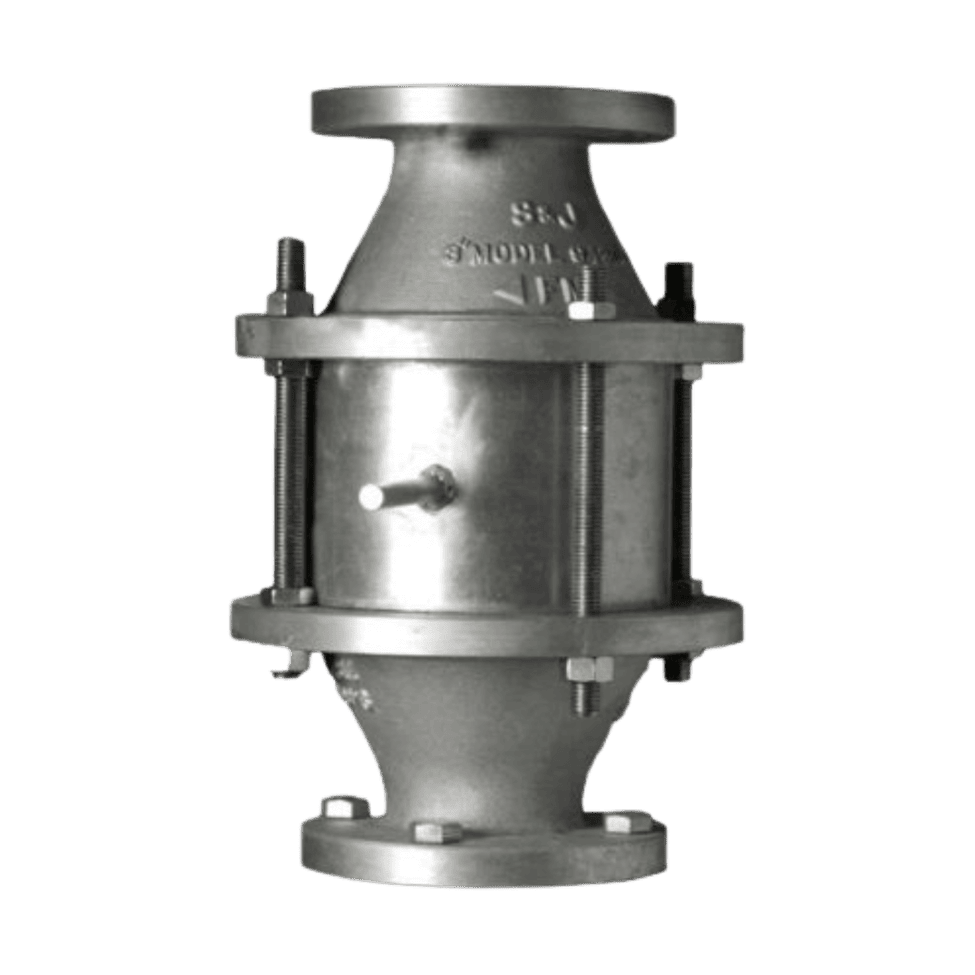
94306
94309
94407
94311–94314
01

Flame, Deflagration & Detonation Arresters

Flame front interruption for tanks, vents, and piping.

What It Is & How It Works

Flame, deflagration and detonation arresters are passive safety devices that prevent a flame front from propagating through tank openings, vent outlets, or interconnected piping into a flammable vapor space. They address the risk of external ignition sources, such as lightning, static discharge, or nearby equipment, reaching stored product through any opening that connects the tank interior to atmosphere or to other vessels.

Each arrester contains a metallic element assembly, typically crimped ribbon or parallel plate, that divides the gas passage into channels smaller than the quenching distance of the target gas group. A flame entering the element loses heat to the metal surfaces faster than combustion can sustain it, extinguishing the flame front while allowing normal vapor flow. The element type, gap size, and housing design determine whether the device arrests a deflagration, a stable detonation, or an unstable detonation.

Arresters mount at tank nozzles, vent pipe terminations, or inline within piping runs. Selection depends on the installation position, the gas group classification, the flame propagation scenario the device must arrest, and the L/D ratio of connected piping that determines whether deflagration can transition to detonation.

Deflagration vs. Detonation: Why It Matters for Arrester Selection

A deflagration is a flame front traveling below the speed of sound, generating moderate pressure. A detonation travels at supersonic speed with a high-pressure shock wave. Standard flame arresters stop deflagrations. Detonation arresters are engineered to withstand the shock energy of a supersonic flame front without structural failure. Specifying the wrong type for the hazard scenario provides no protection. The L/D ratio of connected piping, the gas group, and the potential for deflagration-to-detonation transition determine which device is required.

When to Specify Flame, Deflagration & Detonation Arresters

Flame, deflagration and detonation arresters are specified wherever a flammable vapor space connects to a potential ignition source through an opening, vent, or piping run:

  • Fixed-Roof Petroleum and Chemical Storage Tanks Atmospheric tanks storing flammable liquids where NFPA 30, API 2000, and EPA 40 CFR 60/63 require flame protection at every vent opening that connects the vapor space to atmosphere.
  • Vent Pipe Terminations and Manifolded Vent Systems End-of-line installations at vent pipe outlets or manifolded systems where multiple tanks share a common vent header and a single ignition event could propagate across vessels.
  • Inline Piping Between Tanks or to Vapor Recovery Vapor return lines, vapor recovery unit inlet piping, and tank-to-tank vapor equalization lines where flame propagation through interconnected piping must be interrupted.
  • Biogas and Digester Gas Piping Systems Biogas collection headers and piping between digesters and CHP engines, flares, or upgrading equipment where methane creates continuous flame propagation risk.
  • Facilities Subject to ATEX or IECEx Zone Classification Classified hazardous areas where explosion protection regulations require certified flame interruption devices at defined points in the vapor handling system.
Varec 2500 ATG
02

Why Shand & Jurs Flame, Deflagration & Detonation Arresters Excel

01

Tank Openings Requiring Certified Flame Interruption

End-of-line and tank-mounted arresters provide tested and certified flame interruption at every opening where the vapor space connects to atmosphere, satisfying NFPA 30 and API 2000 requirements for flame protection at storage tanks.

02

Piping Systems Where Deflagration-to-Detonation Transition Is Possible

Detonation arrester models are engineered to arrest supersonic flame fronts with associated shock waves, providing protection in long pipe runs where the L/D ratio creates conditions for deflagration to transition to detonation.

03

Manifolded Vent Systems Connecting Multiple Tanks

Inline arresters installed in shared vent headers prevent a flame event at one tank from propagating through the manifold to other connected vessels, isolating the ignition to a single source.

04

Wet, Corrosive, or High-Humidity Service

Metallic element assemblies and corrosion-resistant housings maintain quenching performance and structural integrity in environments where moisture, chemical exposure, or sulfide-containing gases degrade standard materials.

05

Applications Requiring Low Pressure Drop

Element designs balance quenching gap size against flow resistance, providing effective flame interruption while maintaining pressure drop within the limits required by the tank breathing or vapor recovery system.

06

Facilities Requiring Both Deflagration and Detonation Protection

A full product range from plate element flame arresters through inline deflagration and detonation models allows a single source to address every flame hazard severity level across a facility.

03

Flame Arrester Type — Selection Guide

Attribute End-of-Line / Tank-Mounted Inline Deflagration Inline Detonation
Installation Position
At vent outlet or tank nozzle open to atmosphere Within piping between vessels or to vapor recovery Within piping where long runs create detonation risk
Flame Scenario Arrested
External ignition propagating inward through the vent Deflagration (subsonic flame front) within piping Detonation (supersonic flame front with shock wave)
Typical L/D Ratio
Not applicable (open to atmosphere) Short to moderate pipe runs Long pipe runs exceeding deflagration transition threshold
Pressure Resistance
Low: atmospheric vent service Moderate: deflagration pressures High: detonation shock wave energy
Regulatory Driver
NFPA 30, API 2000, EPA 40 CFR 60/63 NFPA 69, EN 12874, site hazard analysis EN 12874, ATEX/IECEx, site detonation risk assessment
Key Models
94306, 94309 94406, 94407 94311, 94312, 94313, 94314
Recommendation
Specify for every atmospheric vent opening on tanks storing flammable liquids Specify for interconnected piping where deflagration risk exists and L/D ratio is below the detonation transition threshold Specify for long pipe runs where deflagration-to-detonation transition is possible based on gas group and pipe geometry

What to Consider Alongside Flame, Deflagration & Detonation Arresters

  • Normal-operation Tank Breathing You need pressure and vacuum relief for thermal breathing and pumping operations rather than flame interruption. See Conservation Vents & Seals.
  • Fire-case Emergency Overpressure Relief You need large-volume vapor discharge during fire exposure events rather than flame propagation prevention. See Emergency Vents & Manway Covers.
  • Biogas Cover-mounted Flame Protection You need flame arresters specifically configured for digester cover openings in biogas service rather than petroleum or chemical storage. See Biogas Cover Equipment.
  • Biogas Piping System Flame Protection You need inline deflagration or detonation arresters specifically for biogas and digester gas piping between the digester and utilization equipment. See Biogas Stream Equipment.
  • Complete Tank Breathing and Flame Protection Pair end-of-line flame arresters with conservation vents to provide both emissions-controlled tank breathing and flame interruption at the same vent opening. See Conservation Vents & Seals.
  • Integrated Overfill Prevention and Safety Combine tank-mounted flame arresters with L&J Technologies level alarm probes, emergency vents, and Varec FuelsManager® to create a layered protection system covering flame, overfill, and overpressure hazards from sensor to software. See Clairvoyance.
04

Featured Products

01

94306 / 94309 — End-of-Line Flame Arresters

Tank-mounted and vent-outlet flame arresters providing certified flame interruption at atmospheric openings on fixed-roof storage tanks.

02

94406 / 94407 — Inline Deflagration Flame Arresters

Inline flame arresters for piping systems where subsonic deflagration must be interrupted between interconnected vessels or vapor recovery equipment.

03

94311–94314 — Inline Detonation Flame Arresters

Detonation-rated arresters for long pipe runs where gas group and pipe geometry create conditions for deflagration-to-detonation transition.

Bottom section image
Measure.
Monitor.
Protect.