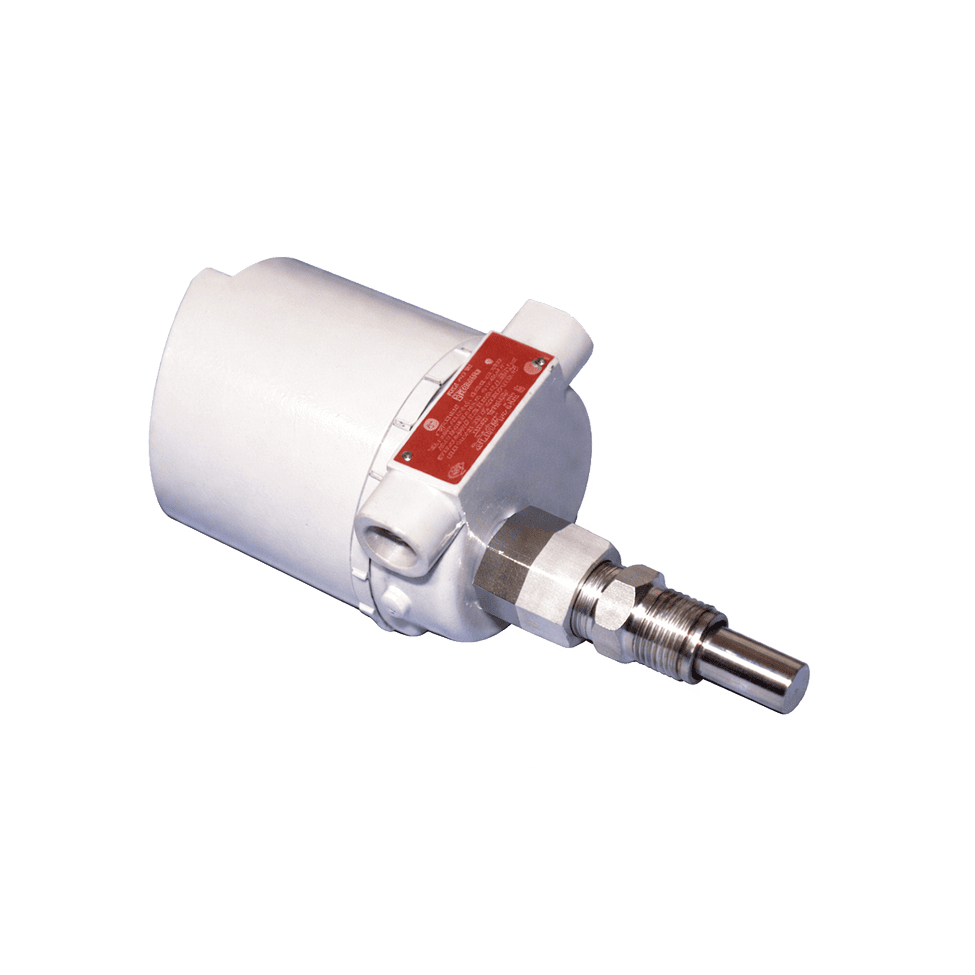
SONAC 110
01

Magnetostrictive Point Level Switches

SONAC 110
Fail-safe point-level protection for liquid service.

What It Is & How It Works

A magnetostrictive level switch is a solid-state point-level device that detects whether liquid is present or absent at a specific height in a tank, vessel, or pipeline. Unlike continuous gauges that report the full liquid level, a switch provides a single binary output, wet or dry, triggering an alarm, pump, interlock, or shutdown when liquid reaches its mounting position.

The switch contains a sealed stainless-steel diaphragm driven at its natural resonant frequency by an internal magnetic circuit. When liquid contacts the sensing tip, the fluid dampens the vibration and changes the magnetic feedback signal. The onboard electronics detect this shift and actuate a relay, delivering a clean, repeatable switching action. Built-in self-diagnostics continuously monitor the sensor, wiring, and electronics, forcing the relay to a predetermined safe state if any fault is detected.

The switch threads directly into a tank nozzle or pipe connection at the required trip-point elevation. Wiring connects to AC or DC power with a double-pole, double-throw relay output that integrates into alarm panels, pump starters, SCADA systems, and API 2350 overfill-prevention architectures. Adjustable time delays filter nuisance trips from splashing, waves, or agitation.

Because the measurement relies on vibration damping rather than dielectric constant, magnetostrictive switches perform consistently across changing products, from crude oil and solvents to water and chemicals, without recalibration when the tank contents change.

Level Switches vs. Level Gauges

A level gauge continuously measures and transmits the exact liquid level for inventory management, custody transfer, or process control. A level switch is a point-level device: it detects whether liquid is present or absent at a fixed position and triggers an alarm, pump, or shutdown. Use a gauge when you need to know how much is in the tank. Use a switch when you need to know that the tank has reached a critical point to activate a protective measure. Gauges measure; switches protect.

When to Choose a Magnetostrictive Switch

Magnetostrictive switches are the right choice when you need reliable, independent point-level detection in liquid service:

  • Petroleum and petrochemical tanks High-level shutdown and overfill protection for crude, refined products, solvents, and blending operations under API 2350 and EPA SPCC requirements.
  • Chemical and pharmaceutical vessels Accurate level detection despite vapor, foam, or changing product properties, with hazardous-area approvals for classified environments.
  • Pump sumps, separators, and condensate receivers Reliable high- or low-level alarms for pump control, dry-run protection, and process interlocks under pressure.
  • Power & Industrial Process Plants Boiler feed tanks, cooling systems, and lube oil reservoirs where fail-safe switching prevents equipment damage or process upset.
  • Hazardous locations Explosion-proof enclosure options per NEC and NEMA 4/5/7/9/12 ratings for installations in classified atmospheres.
SONAC 110
SONAC 110 Ultrasonic Level Switch
02

Why It Excels

01

Tanks Handling Multiple or Changing Liquid Products

Vibration-damping measurement is independent of dielectric constant, so the switch performs consistently across product changes without recalibration.

02

High-Pressure or Extreme-Temperature Process Vessels

Sealed stainless-steel construction handles up to 2,000 psig and −40 to 220 °F, maintaining reliable switching in demanding service.

03

Safety-Critical Applications Requiring Continuous Self-Verification

Built-in diagnostics monitor the sensor, wiring, and electronics on every cycle, forcing the relay to a safe state on any detected fault.

04

Turbulent Tanks or Vessels with Agitation and Splashing

Adjustable time delays filter nuisance trips from waves, filling turbulence, or mechanical agitation without masking genuine level events.

05

Installations Requiring Minimal Ongoing Maintenance

No moving mechanical parts, no recalibration drift, and no product-specific adjustments reduce long-term service burden.

06

Compact Nozzles or Pipe Connections with Limited Clearance

A probe tip of less than ¼ inch intrudes minimally into the process, fitting standard threaded connections without internal obstructions.

03

Choosing the Right Switch Technology

Attribute Magnetostrictive Ultrasonic Non-Contact
Measurement Principle
Resonant vibration damping of a sealed diaphragm Ultrasonic acoustic feedback between matched transmitter/receiver sensors Pulsed X-band microwave (10.525 GHz) transmitter/receiver pair
Contact Type
Contact (minimal probe tip intrusion) Contact (sensors face each other across air gap) Non-contact (detects through non-metallic windows)
Primary Media
Liquids only Solids, granular materials, fragile products Liquids or solids through non-metallic windows
Typical Applications
Overflow alarm, high/low liquid level, small vessels and pipes Bulk solids level, position detection, plugged chute, fragile materials External level detection, aggressive or hot products, bins and chutes
Fail-Safe Capability
Self-testing circuit forces relay to safe state on fault Internal self-test Selectable fail-safe (high/low)
Pressure Rating
Up to 2,000 psig Not pressure-rated (ambient/air-gap use) Window-dependent; microwave head not pressure-rated
Intrusion Into Process
Minimal (< ¼″ probe tip) Non-intrusive to solids (air gap) No intrusion
Sensitivity to Product Properties
Unaffected by dielectric constant; works across product changes Affected by humidity and temperature (auto-adjust frequency) Response varies with dielectric constant and conductivity
Maintenance
No moving parts; periodic function check Clean sensors; verify alignment Align windows; keep path clear
Not Recommended For
Solids, powders, aerated slurries Heavy slurries or high-viscosity liquids Direct immersion in liquids
Quick Pick
Choose the Sonac 110 for liquid level alarms where pressure tolerance, self-diagnostics, and dielectric-independent detection matter. Choose the Sonac 220 for bulk solids, powders, or fragile materials where non-intrusive, through-air detection is needed. Choose the Microwave 320 for extreme temperatures, aggressive products, or applications requiring completely non-contact detection through tank walls or windows.

What to Consider Alongside Magnetostrictive Switches

Consider an alternative when:

How this technology fits into a larger system

Point level switches provide independent safety and alarm layers that operate alongside continuous gauges and inventory software. In API 2350 overfill prevention architectures, the switch is not a substitute for continuous measurement but rather an additional protection layer.

  • Independent alarm layer for continuous gauging systems. Pair with Servo, Radar, or Magnetostrictive Level Gauges as a separate high-level alarm trip. The switch operates independently of the continuous gauge, providing an API 2350-compliant overfill-prevention layer that functions even if the primary measurement fails. See Magnetostrictive Level Gauges, Radar Level Gauges, or Servo Level Gauges.
  • Centralized alarm management across the tank farm. Connect relay output to FuelsManager® or your SCADA for real-time alarm status, automated compliance logging, and consolidated alarm handling across multiple tanks. See FuelsManager®.
04

Featured Product

01

Sonac 110 — Magnetostrictive Liquid Level Switch

Self-checking liquid level switch with fail-safe relay output for overfill protection and process alarms in hazardous and industrial environments.

Bottom section image
Measure.
Monitor.
Protect.