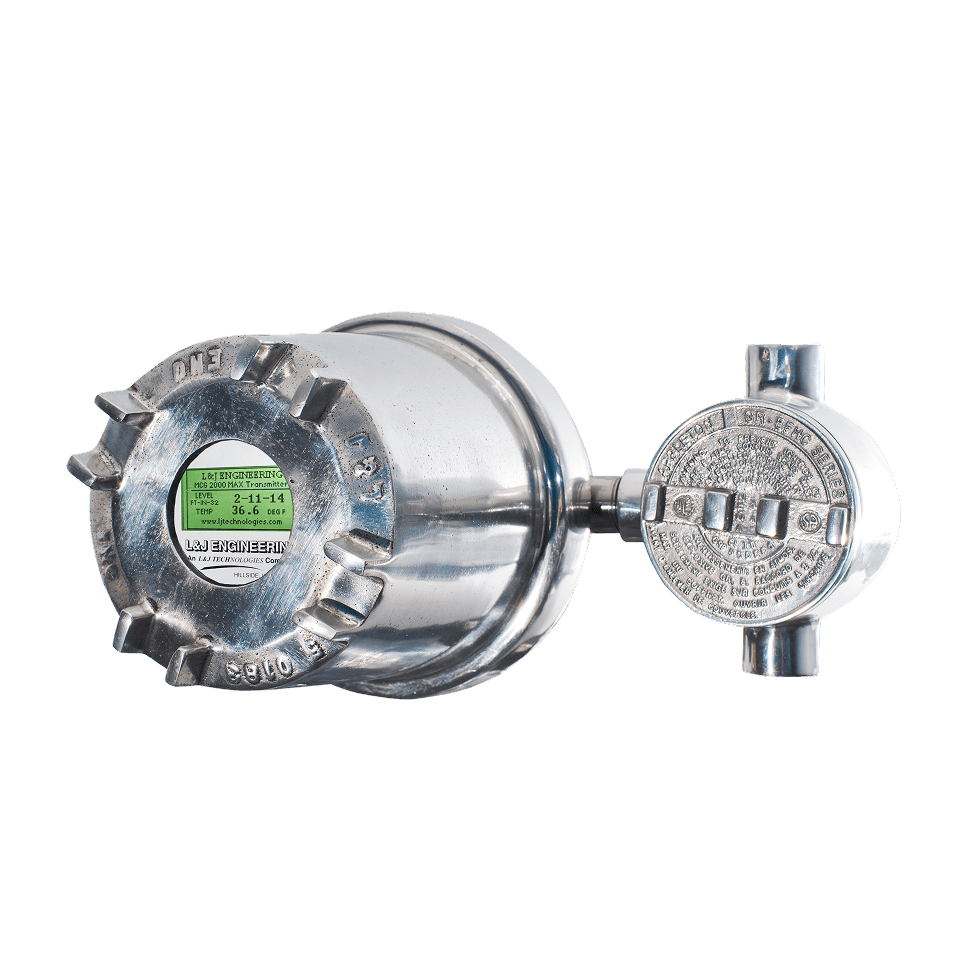
A float and tape transmitter converts the mechanical movement of an existing float and tape gauge into a continuous electronic signal, bridging the gap between proven mechanical level measurement and modern digital tank-farm infrastructure. The transmitter mounts directly onto the gauge head and reads the tape position using a magnetic or capacitive absolute encoder as the float tracks the liquid surface.
The data flow is straightforward: the float follows the liquid level, the tape drives the encoder, and the transmitter outputs real-time level data, and, optionally, temperature or other data inputs, over 4–20 mA, HART, Modbus, L&J Tankway, or other digital protocols to a control system, SCADA host, or inventory management software. Because absolute encoding holds the exact tape position in memory, the transmitter never loses its reading after a power interruption and automatically resumes reporting the correct level when power is restored.
Installation follows familiar float and tape practices: mount the transmitter to the gauge head, ensure proper tape tension, and connect power and signal wiring. Loop-powered models require no external power supply or batteries, simplifying deployment on remote or infrastructure-limited tanks. Once configured, the transmitter continuously reports level and temperature to the host system, providing a seamless path into automated inventory and API 2350 overfill-prevention architectures.
The mechanical gauge remains fully intact. Local visual indication stays available at the tank, including during power loss or communication failure, preserving the power-independent readout that many facilities require as a redundant safety layer.
Both approaches deliver digitized level data to a control system. Adding a transmitter to an existing float and tape gauge preserves the mechanical indication and avoids replacing the tank penetration, gauge mounting, and field wiring. Replacing the gauge entirely with radar or servo provides additional capabilities such as non-contact operation, density, or interface detection, but requires new installation and eliminates the power-independent mechanical readout.
Choose a float and tape transmitter upgrade for digital connectivity while retaining your mechanical gauge.
Choose a replacement with servo level gauges when the application requires capabilities beyond level measurement, such as interface, density, and BS&W measurement. Choose a radar level gauge for upgraded level accuracy and precision specifications in a non-contact manner.
A transmitter is the right addition when you need electronic data from a mechanical gauge without sacrificing its inherent reliability:
Transmitters mount directly to the gauge head with no gauge replacement, providing a low-cost modernization path to digital connectivity.
Loop-powered operation requires no batteries or external supply at the tank, simplifying installation on remote or minimally wired sites.
Explosion-proof and intrinsically safe designs enable safe operation in classified locations without compromising measurement continuity.
Absolute encoding delivers up to 1/32-inch accuracy while the float and tape system provides direct, visible level indication underneath.
Absolute encoding holds position through outages and resumes correct level reporting automatically when power returns, with no re-zeroing required.
The mechanical measurement is unaffected by vapor density, dielectric constant, or foam, and the transmitter digitizes what the float already measures.
Consider an alternative when:
Magnetic absolute encoding to 1/32-inch accuracy with ultra-low power loop-powered operation and broad protocol support, ideal for converting mechanical gauging to reliable digital output in demanding or variable environments where robustness and long-term stability are critical.
Capacitive absolute encoding with touch-screen display, integrated temperature input, and multi-device connectivity, best suited for inventory systems requiring local configuration, rich I/O, and seamless integration with gauges and software platforms.