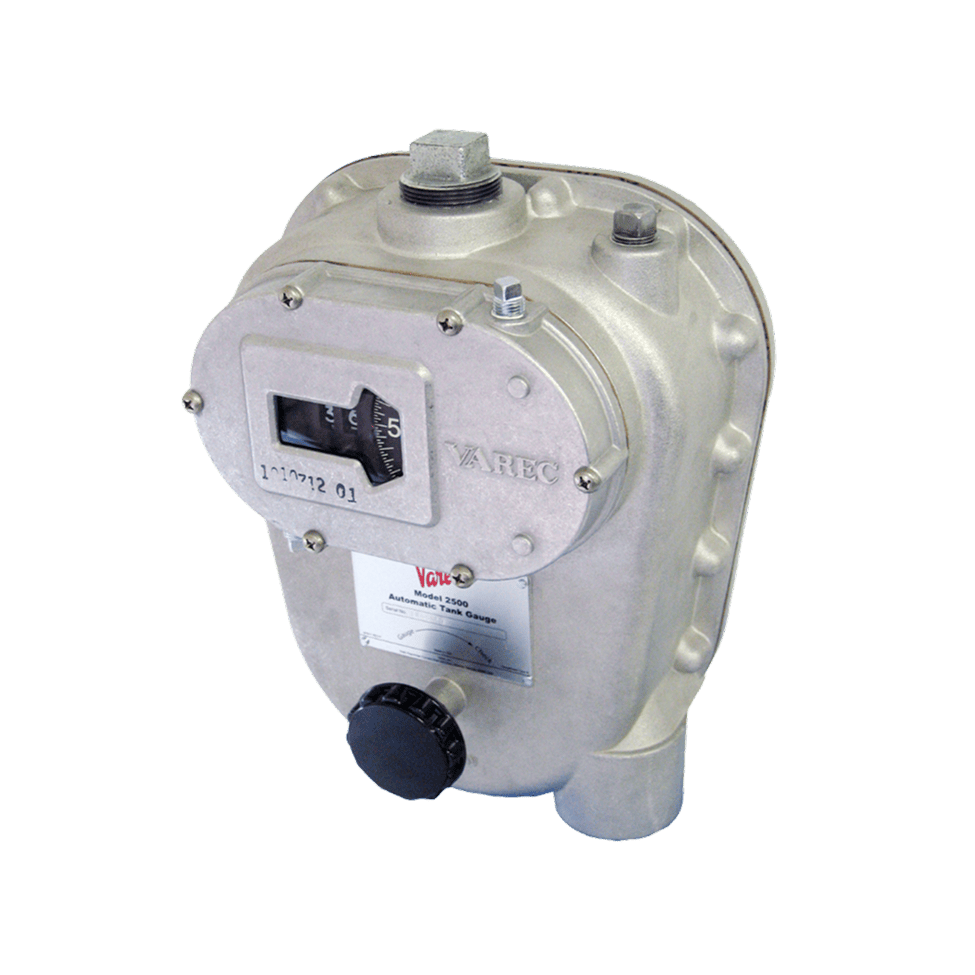
A float and tape level gauge uses a buoyant stainless-steel float riding directly on the liquid surface, connected by a perforated tape to a precision counter mechanism at the tank roof or ground level. As the liquid rises or falls, the float moves the tape, rotating a drum and producing a continuous mechanical level reading without external power.
The measurement is driven entirely by buoyancy and gravity. The float tracks the surface, the tape transmits that motion, and the counter displays level in feet, inches, and fractions. Because there is no electrical signal in the measurement path, the gauge holds its reading through power outages, lightning, and harsh process conditions, making it the standard for visible, fail-safe level indication.
Installation involves mounting the gauge head on a tank nozzle and running the float assembly vertically through the product. Guide wires, stilling pipes, or pan floats maintain stable operation in turbulent tanks or those with internal obstructions. Fixed-roof, floating-roof, cone-roof, and pressurized configurations are all supported.
Accuracy reaches ±1/16 inch over the full measurement range. Modular cartridge assemblies simplify field maintenance. For facilities requiring remote monitoring, a digital transmitter mounts directly to the gauge head, converting float motion into 4–20 mA, HART, or Modbus output while preserving the local mechanical readout.
Float and tape gauges provide a direct mechanical reference to the liquid surface, always visible without power. Radar gauges calculate level electronically via microwave signal, with no moving parts. Many terminal operators use both: radar as the primary electronic gauge, float and tape as the mechanical verification that remains readable during power loss or system failure.
Choose radar for non-contact, low-maintenance electronic measurement.
Choose float and tape for mechanical reliability, local visibility, and power-independent operation.
Float and tape gauges are selected when visible mechanical indication, power-independent operation, and long-term reliability drive the decision:
Purely mechanical operation maintains a readable level indication when electronic systems are offline.
Operators read the level directly from the counter without instruments, radios, or control room access.
Simple tape-and-drum mechanism with modular cartridge design extends service life and simplifies field repair.
Provides a technology-diverse second measurement for custody-transfer audits under API 2350 and OIML frameworks.
Adding a transmitter creates a dual-output system, retaining mechanical indication while feeding digital data to SCADA or FuelsManager®.
Consider an alternative when:
The industry-standard float and tape gauge with over 90 years of field history. Designed for general bulk storage across petroleum, chemical, and water applications with a range of float and tape configurations for different tank types and products. Pair with a Varec 2920 FTT or L&J MCG 2000MAX transmitter for hybrid mechanical-digital operation.
Float & tape gauge engineered for pressurized bulk storage applications. Rated for higher-pressure service where standard ATGs cannot be used, while maintaining the same mechanical reliability and local indication.