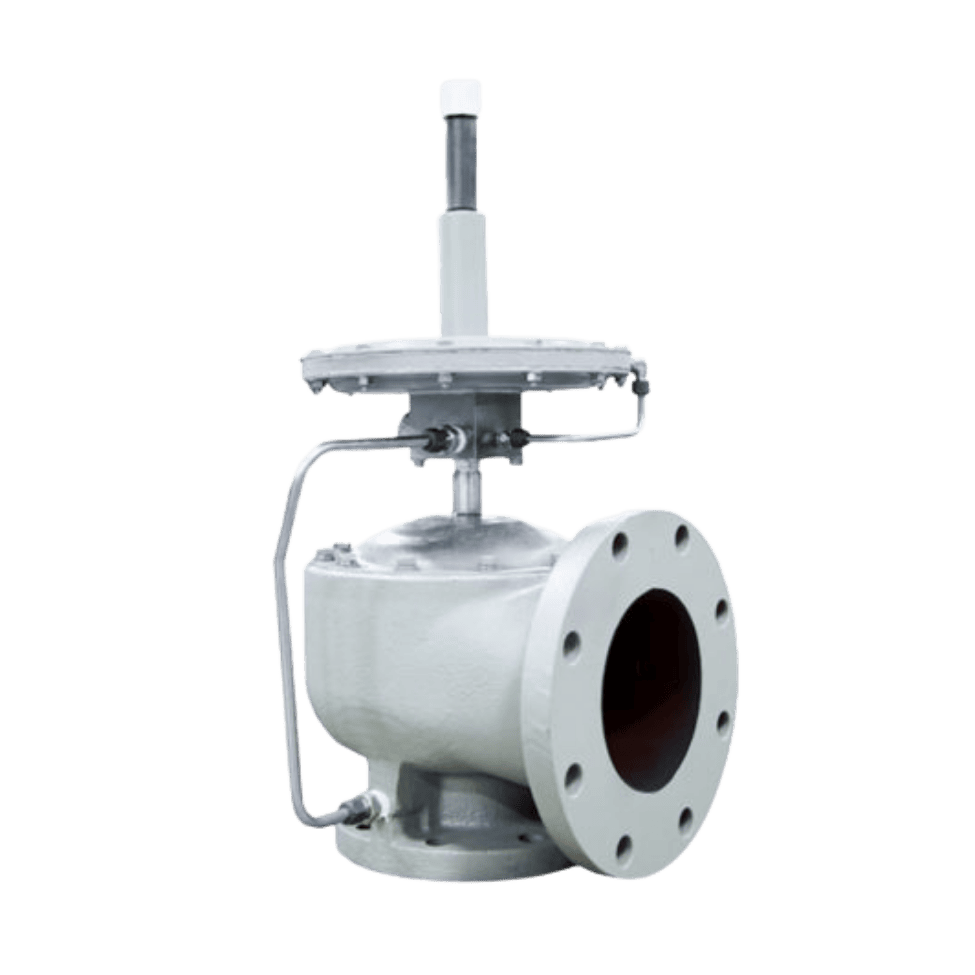
94640
94110
94640
94645
01

Pilot-Operated Relief Valves

Precision pressure and vacuum control for storage tanks.

What It Is & How It Works

Pilot-operated relief valves are tank-mounted pressure and vacuum relief devices that use a sensing pilot to control the opening and closing of a larger main valve. They protect atmospheric and low-pressure storage tanks from overpressure and vacuum damage during thermal breathing, product transfer, and fire exposure. Unlike weight-loaded conservation vents, pilot-operated valves maintain a tight seal at pressures very close to the set point, significantly reducing fugitive vapor emissions during normal tank operation.

The pilot assembly continuously senses tank pressure through a small sensing line. When pressure exceeds the set point, the pilot opens and directs tank pressure to the main valve piston or diaphragm, driving the main valve fully open in a snap-action response. When pressure falls below the set point, the pilot closes and the main valve reseals. This snap-action characteristic means the main valve is either fully closed or fully open, eliminating the throttling losses and seat wear that occur with modulating relief devices.

Pilot-operated relief valves mount on standard tank roof nozzles in the same locations as conservation vents and are sized per API 2000 for thermal breathing and pumping loads. Set points are adjusted at the pilot without removing the main valve body, simplifying field recalibration.

Pilot-Operated vs. Weight-Loaded Relief

Weight-loaded conservation vents lift gradually as pressure builds, allowing some vapor leakage near the set point. Pilot-operated valves remain fully sealed until the pilot triggers a snap-action opening, then reseal completely when pressure normalizes. This difference makes pilot-operated valves the better choice when emission reduction, higher relief capacity, or tighter set-point accuracy is required. Weight-loaded vents protect simply; pilot-operated valves protect precisely.

When to Specify Pilot-Operated Relief Valves

Pilot-operated relief valves are specified when a tank requires tighter emission control, higher relief capacity, or more precise set-point management than weight-loaded vents can deliver:

  • Tanks Subject to EPA 40 CFR 60/63 Fugitive Emission Limits Fixed-roof tanks where vapor losses through the vent device must be minimized to meet NSPS and NESHAP emission thresholds, and where the tighter seal of a pilot-operated valve directly reduces the facility’s reported emissions inventory.
  • Low-Pressure Storage Requiring API 2000 Compliance Atmospheric and low-pressure tanks where API 2000 sizing calculations demand higher relief capacity than weight-loaded vents can provide at the available nozzle size, allowing a pilot-operated valve to deliver full-rated flow through a smaller opening.
  • Tanks with Narrow Operating Pressure Ranges Vessels where the margin between normal operating pressure and the relief set point is small, requiring the snap-action response and tight reseal of a pilot-operated valve to prevent chronic seat leakage during routine pressure fluctuations.
  • Chemical and Petrochemical Storage with Corrosive Vapors Tanks storing products whose vapors degrade the sealing surfaces of weight-loaded vents over time, where the positive sealing action of a pilot-operated design extends service life and maintains emission compliance between maintenance intervals.
  • High-Throughput Terminals with Frequent Filling and Emptying Cycles Multi-tank terminals where rapid product transfer creates large pressure and vacuum swings, requiring relief valves that open fully at precise set points and reseal immediately to minimize cumulative vapor losses across hundreds of annual transfer cycles.
Varec 2500 ATG
02

Why Shand & Jurs Pilot-Operated Relief Valves Excel

01

Facilities Where Fugitive Emissions Drive Regulatory Costs

The snap-action seal eliminates the seat leakage that weight-loaded vents allow near the set point, reducing the vapor losses that contribute to Title V emission inventories and LDAR reporting obligations.

02

Tanks Requiring High Relief Capacity Through Limited Nozzle Sizes

Pilot-operated valves deliver full-rated relief flow as soon as the pilot triggers, achieving higher effective capacity than a weight-loaded vent of the same nozzle diameter because the main valve opens fully rather than proportionally.

03

Operations Requiring Precise, Repeatable Set-Point Control

The pilot mechanism provides set-point accuracy within narrow tolerances that remain stable across temperature changes, allowing consistent protection without the seasonal set-point drift that can affect spring or weight-loaded devices.

04

Tanks with Both Pressure and Vacuum Relief Requirements

Combined pressure and vacuum pilot-operated valves address both relief directions in a single device with independent pilot circuits, simplifying the tank roof layout and reducing the number of penetrations required.

05

Installations Where Field Maintenance Must Be Fast and Simple

Set-point adjustments are made at the pilot without removing the main valve body from the tank nozzle, reducing maintenance time and eliminating the need to break the tank seal for routine recalibration.

03

Pilot-Operated Relief Valve Configurations — Selection Guide

Attribute Pressure Relief Only Vacuum Relief Only Combined P/V Relief
Primary Function
Relieves overpressure caused by thermal expansion, inert gas blanketing, or rapid filling Relieves vacuum caused by thermal contraction, rapid product withdrawal, or condensation Provides both pressure and vacuum relief in a single device for tanks with bidirectional breathing requirements
Pilot Configuration
Single pressure-sensing pilot with piston or diaphragm main valve Single vacuum-sensing pilot with piston or diaphragm main valve Dual independent pilot circuits, one for pressure and one for vacuum, sharing a common main valve body
Typical Set-point Range
0.5 to 15 oz/sq in. (0.2 to 6.5 kPa) for atmospheric tanks 0.5 to 8 oz/sq in. (0.2 to 3.5 kPa) for atmospheric tanks Pressure and vacuum set points adjusted independently at each pilot circuit
When to Specify
Tanks where vacuum relief is handled by a separate device or is not required due to inert gas blanketing design Tanks where pressure relief is handled by a separate device, such as a blanketing valve or pressure relief valve Tanks requiring both pressure and vacuum breathing protection where a single device simplifies installation and reduces roof penetrations
Regulatory Driver
API 2000 (pressure relief sizing), EPA 40 CFR 60/63 (emission control) API 2000 (vacuum relief sizing), API 650 (tank structural integrity) API 2000 (combined relief sizing), EPA 40 CFR 60/63 (emission control), NFPA 30 (flammable liquids)
Typical Pairing
Paired with a separate vacuum vent or vacuum pilot valve on the same tank Paired with a separate pressure vent or blanketing valve on the same tank Standalone breathing protection device, paired with emergency vents and flame arresters for complete tank safety
Recommendation
  • Specify when pressure and vacuum relief are sized or controlled independently, or when only pressure relief is needed at a particular nozzle
  • Specify when the tank has a dedicated pressure relief path and requires a separate, precisely controlled vacuum relief device
  • Specify as the default choice for most atmospheric and low-pressure tanks where a single device reduces complexity and maintenance

What to Consider Alongside Pilot-Operated Relief Valves

  • Low-pressure Tanks Where Emission Tightness is Not Critical Standard weight-loaded conservation vents provide reliable breathing protection at lower cost and complexity when the tank’s emission profile does not require the tighter seal of a pilot-operated valve. See Conservation Vents & Seals.
  • Emergency Overpressure Relief for Fire-case Scenarios Pilot-operated relief valves are sized for normal breathing and pumping loads, not for the large-volume relief required during external fire exposure. See Emergency Vents & Manway Covers.
  • Tanks Requiring Only Free-venting Atmospheric Discharge When the tank operates at atmospheric pressure and requires only an open-pipe vent with weather protection rather than a set-point-controlled relief device. See Free Vents.

5B — How pilot-operated relief valves fit into a larger system

  • Complete Tank Breathing and Safety Assembly Pair pilot-operated relief valves with flame arresters at the vent outlet, emergency vents for fire-case protection, and gauge hatches for vapor-tight access to create a fully protected tank roof that addresses normal breathing, emergency relief, ignition prevention, and operational access. See Flame & Detonation Arresters, Emergency Vents & Manway Covers, and Gauge Hatches & Manway Covers.
  • Emission Monitoring and Compliance Reporting Combine pilot-operated relief valves with L&J Technologies level and temperature instrumentation feeding Clairvoyance to correlate tank breathing events with inventory movements, providing the data trail needed for EPA emission calculations and LDAR compliance reporting.
04

Featured Products

01

94640/94110 — Pilot-Operated Pressure/Vacuum Relief Valve

Combined pressure and vacuum relief for atmospheric storage tanks, delivering snap-action response and tight reseal to minimize fugitive emissions during normal breathing and product transfer.

02

94640 — Pilot-Operated Pressure Relief Valve

Pressure-only relief for tanks with separate vacuum protection, providing precise set-point control and high relief capacity for inert-gas-blanketed or positive-pressure storage applications.

03

94645 — Pilot-Operated Vacuum Relief Valve

Vacuum-only relief for tanks with separate pressure protection, preventing structural vacuum damage during rapid withdrawal or thermal contraction with snap-action vacuum break response.

Bottom section image
Measure.
Monitor.
Protect.