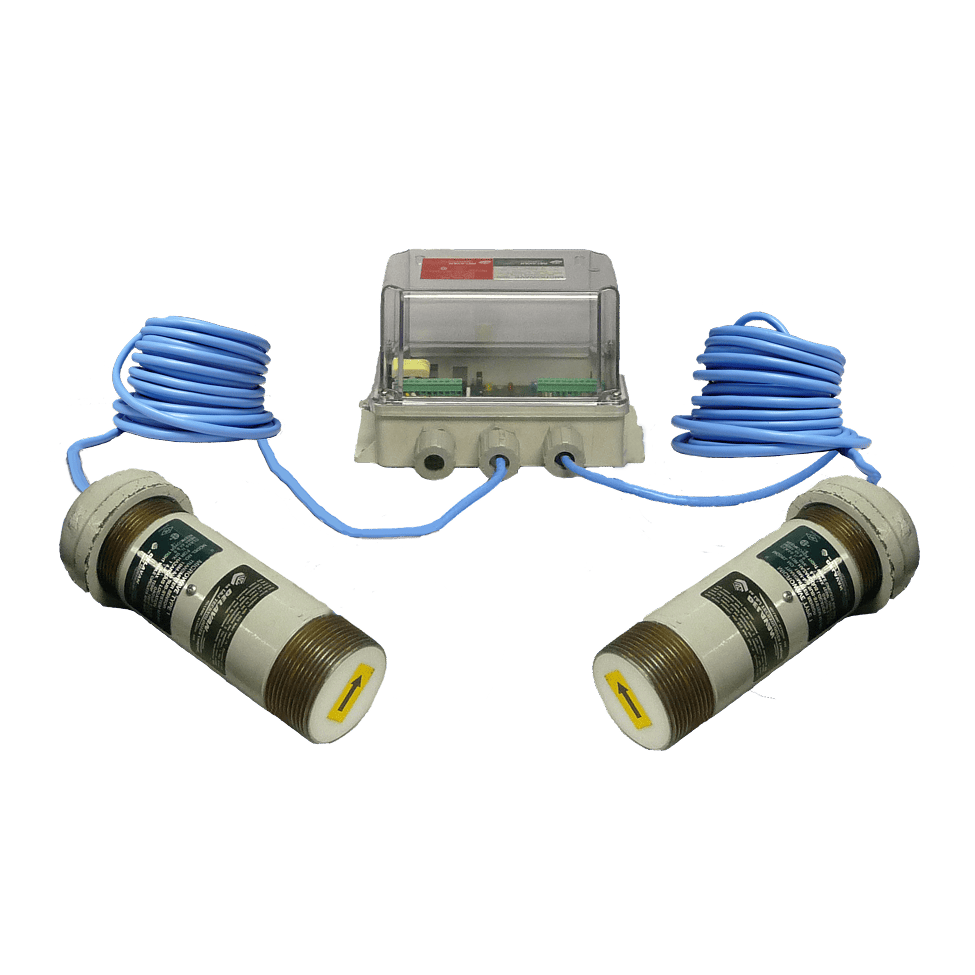
Microwave 320
01

Microwave Point Level Switches

Microwave 320
Non-contact detection for extreme service.

What It Is & How It Works

A microwave point level switch detects the presence or absence of material at a fixed point using an X-band (~10 GHz) beam transmitted between a paired transmitter and receiver mounted on opposite sides of a vessel, chute, or bin. When the beam path is clear, the receiver picks up a strong, uninterrupted signal. When liquid or solid material enters the path, it absorbs or blocks the microwave energy, triggering a relay to actuate an alarm or control action.

Because neither sensor contacts the process, the Microwave 320 can be installed behind non-metallic windows (glass, ceramic, PTFE, or UHMW) without penetrating the vessel wall. This makes microwave detection uniquely suited for extreme temperatures, aggressive or abrasive materials, and sealed vessels where hygiene or pressure boundaries must remain intact. When material interrupts the beam, the signal drop actuates a relay with selectable fail-safe and adjustable on/off time delays, integrating directly into alarm panels, pump starters, or SCADA systems.

Mount the transmitter and receiver on opposite sides of the vessel, align their beams, and connect the control unit. Adjustable gain, selectable fail-safe modes, and flexible time-delay settings allow precise tuning to the process. Optional waveguides and water-cooled heads extend operation into environments reaching 750 °F. The system supports long cable runs between sensor heads and control unit, providing retrofit flexibility in spread-out facilities.

One important limitation: microwaves cannot penetrate metal walls. For metallic vessels, a non-metallic window must be installed at the detection point. The transmitter and receiver also require line-of-sight alignment, so tight geometries or very short spans may favor a compact probe-style switch instead.

Microwave Switch vs. Ultrasonic Switch

Both the Microwave 320 and Sonac 220 provide non-intrusive point level detection without contacting the product. The Sonac 220 uses ultrasonic acoustic feedback across an air gap, suited for standard bulk solids below 400 °F. The Microwave 320 transmits pulsed microwave energy through sealed vessel walls or windows, handling temperatures up to 750 °F and aggressive environments that would damage ultrasonic sensor housings. Choose ultrasonic switches for routine solids detection.

Choose microwave switches for extreme heat, sealed vessels, or corrosive products.

When to Choose Microwave Switches

Microwave switches are the right choice when you need completely non-contact detection in conditions too severe for ultrasonic or mechanical switches:

  • Cement, Power, & Mining Kiln feed, clinker discharge, and baghouse applications where temperatures exceed 400 °F and abrasive materials destroy intrusive probes.
  • Blocked-chute and crusher/breaker plug detection Plug detection on crushers, feeders, and pneumatic conveying lines handling hot or aggressive bulk solids.
  • Sealed or hygienic vessels Applications where no sensor penetration is permitted and detection must occur through non-metallic windows to maintain pressure or hygiene boundaries.
  • Waste-to-energy, coal and biomass systems Coal handling, RDF, wood chips, and sludge transfer systems where dust, steam, and high temperatures coexist.
  • Corrosive chemical process vessels Vessels handling corrosive powders, pellets, or hot liquids where contact-based switches degrade rapidly.
Microwave 320
Microwave 320
02

Why It Excels

01

Process Temperatures Up to 750 °F

Water-cooled heads and high-temperature weldments allow continuous operation in extreme heat that conventional switch technologies cannot survive.

02

Aggressive, Abrasive, or Corrosive Materials

No sensor contacts the product, so there is nothing to wear, foul, corrode, or contaminate.

03

Sealed Vessels Requiring No Process Penetration

Installs behind non-metallic windows (glass, ceramic, PTFE, UHMW) to maintain pressure and hygiene boundaries.

04

Dusty, Steamy, or Vapor-Laden Environments

Microwave energy penetrates dust, steam, and vapor without signal degradation, maintaining reliable detection in conditions that challenge alternate sensing methods.

05

Facilities Requiring Long Cable Runs

Supports extended head-to-control cabling for retrofit flexibility in spread-out plants where sensor and control unit cannot be co-located.

03

Choosing the Right Switch Technology

Attribute Sonac 110 Magnetostrictive Sonac 220 Ultrasonic Microwave 320 Microwave
Detection principle
Vibration damping of a resonant diaphragm Ultrasonic acoustic feedback between matched Tx/Rx Pulsed X-band microwave barrier between Tx/Rx pair
Contact type
Contact (minimal probe tip intrusion) Non-intrusive (sensors face each other across air gap) Non-contact (installs behind non-metallic windows or across gap)
Primary media
Liquids only (crude, refined products, solvents, water, chemicals) Solids, granular materials, powders, fragile products (≥¼ lb/ft³) Liquids or solids through non-metallic windows; requires window for metal tanks
Pressure rating
Up to 2,000 psig Not pressure-rated (ambient/air-gap use) Window/weldment dependent; microwave head is not pressure-rated
Process temperature
−40 to 220 °F Up to 400 °F (Ryton sensor) Up to 750 °F with high-temp weldments
Fail-safe capability
Self-testing circuit forces relay to safe state on fault Internal self-test Selectable fail-safe (high/low)
Not recommended for
Solids, powders, aerated slurries Heavy slurries or high-viscosity liquids Direct immersion in liquids
Quick pick
Choose the Sonac 110 for liquid level alarms where pressure tolerance, self-diagnostics, and dielectric-independent detection matter. Choose the Sonac 220 for bulk solids, powders, and fragile materials where non-intrusive, through-air detection below 400 °F is sufficient. Choose the Microwave 320 for extreme temperatures, aggressive products, or applications requiring completely non-contact detection through tank walls or windows.

When to Consider Alternative Technologies

Consider an alternative when:

How this technology fits into a larger system

Microwave switches serve as alarm and control layers in process lines and material handling systems, often alongside continuous measurement instruments.

  • Cap-Analog Capacitance Transmitters as the continuous measurement device on the same vessel or process line, with the Microwave 320 providing an independent high or low alarm trip for overfill prevention, empty detection, or plugged-chute protection.
  • Sonac 110 Magnetostrictive Switches as a complementary switch at the top of a secondary tank on the same process, where one location requires through-wall detection and the process tank needs an overfill switch in the same system.
03

Featured Product

01

Microwave 320 — Non-Contact Microwave Barrier Switch

Pulsed X-band microwave barrier for completely non-contact point level detection in liquids or solids, with options for extreme service up to 750 °F.

Bottom section image
Measure.
Monitor.
Protect.