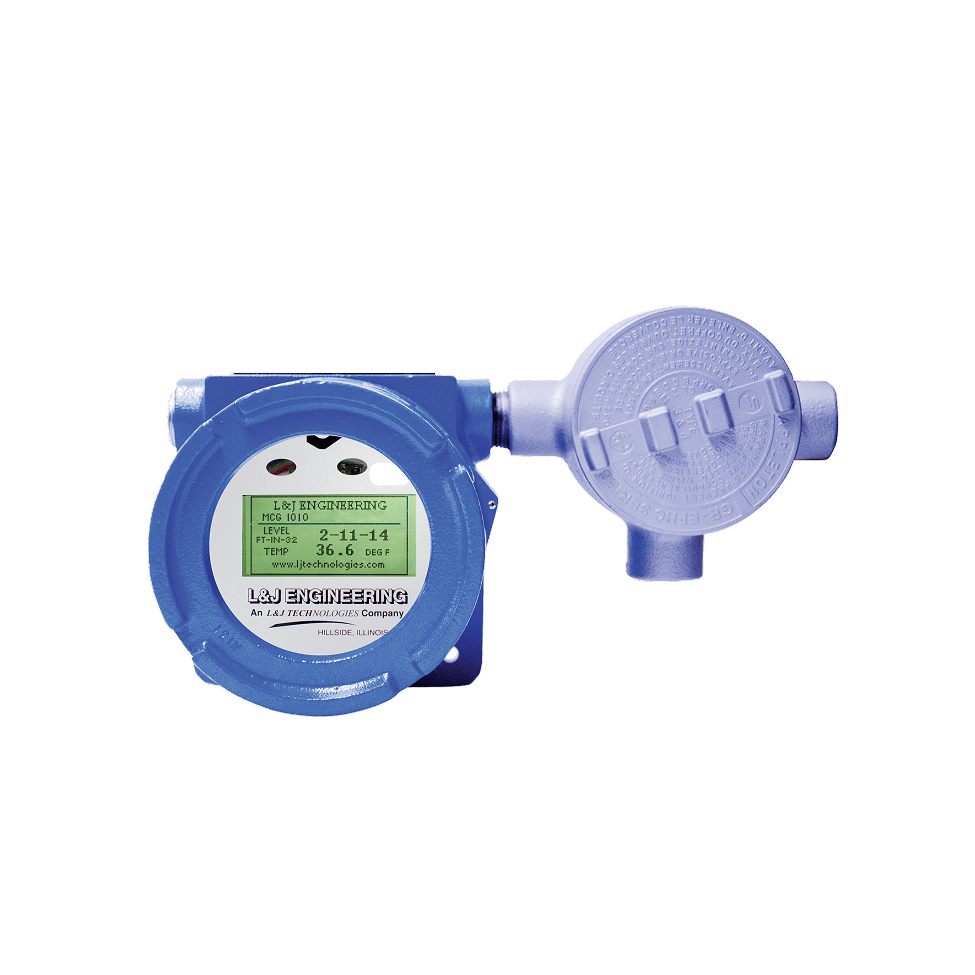
A data transmitter is a microprocessor-based field device that receives analog and digital inputs from tank-side instruments, converts them into standardized digital protocols, and delivers that data to a control system, inventory software, or SCADA host. It is the link between what happens at the tank and what operators see in the control room.
The data flow follows a consistent path: level gauges, temperature probes, pressure transducers, and discrete sensors connect their 4–20 mA, RTD, or RS-485 signals to the transmitter’s input terminals. The transmitter digitizes those inputs, displays them on a local graphical LCD, and publishes the data upstream over a variety of supported protocols. Because the transmitter aggregates multiple inputs at the tank, it eliminates individual analog cable runs to the control room, reducing cabling and installation cost.
Transmitters mount in explosion-proof enclosures at or near the tank. Field wiring enters through conduit connections with integrated lightning and surge protection. All configuration and calibration is performed through infrared programming using a remote calibrator, which communicates through the sealed glass window of the enclosure, so the housing cover never needs to be removed in hazardous environments. Flash memory enables firmware updates in the field without replacing hardware.
One important detail: data transmitters accept signals from any compatible field instrument, not just one gauge type. A single transmitter can simultaneously process level from a radar gauge, temperature from an RTD probe, pressure from a transducer, and discrete contact status from alarm switches, publishing all of it as a unified data set to the host system.
Both devices digitize tank measurements, but they serve different system roles. A float and tape transmitter mounts directly to a mechanical gauge and encodes that gauge’s tape position into a digital signal. A data transmitter is instrument-agnostic: it accepts standardized signals from any combination of gauges, probes, and sensors and converts them to digital protocols. Choose a float and tape transmitter to digitize a specific mechanical gauge. Choose a data transmitter when the system requires multi-input aggregation, protocol conversion, or integration with instruments beyond a single gauge. See Float & Tape Transmitters.
Data transmitters are the right choice when tank-side instruments need a reliable path into digital infrastructure:
One transmitter aggregates level, temperature, pressure, and discrete inputs, eliminating individual analog cable runs to the control room.
Infrared calibration through a sealed glass window means the explosion-proof housing is never opened for programming, maintaining the integrity of the hazardous-area rating.
Configurable output protocols allow a single transmitter model to integrate with L&J Tankway, Mark Space, Modbus, HART, or other host system protocols depending on the installation.
Flash memory retains all configuration and calibration data through power cycles, and absolute level data resumes immediately on power restoration with no re-zeroing required.
New protocols and functionality can be downloaded to flash memory in the field without replacing hardware, extending the useful life of the installed base.
Consider an alternative when:
Microprocessor-based tank hub with direct RS-485 radar connectivity, multi-input aggregation, and local graphical LCD for evo-series installations.
High-capacity RTU with broad analog and digital I/O, multi-protocol support, and flexible power options for diverse tank-gauging applications.