410
4100
420
421
500
510
511
514
520
01

Capacitance Level Gauges & Switches

410,4100,420,421,500,510,511,514,520
Versatile measurement for liquids, slurries, and solids.

What It Is & How It Works

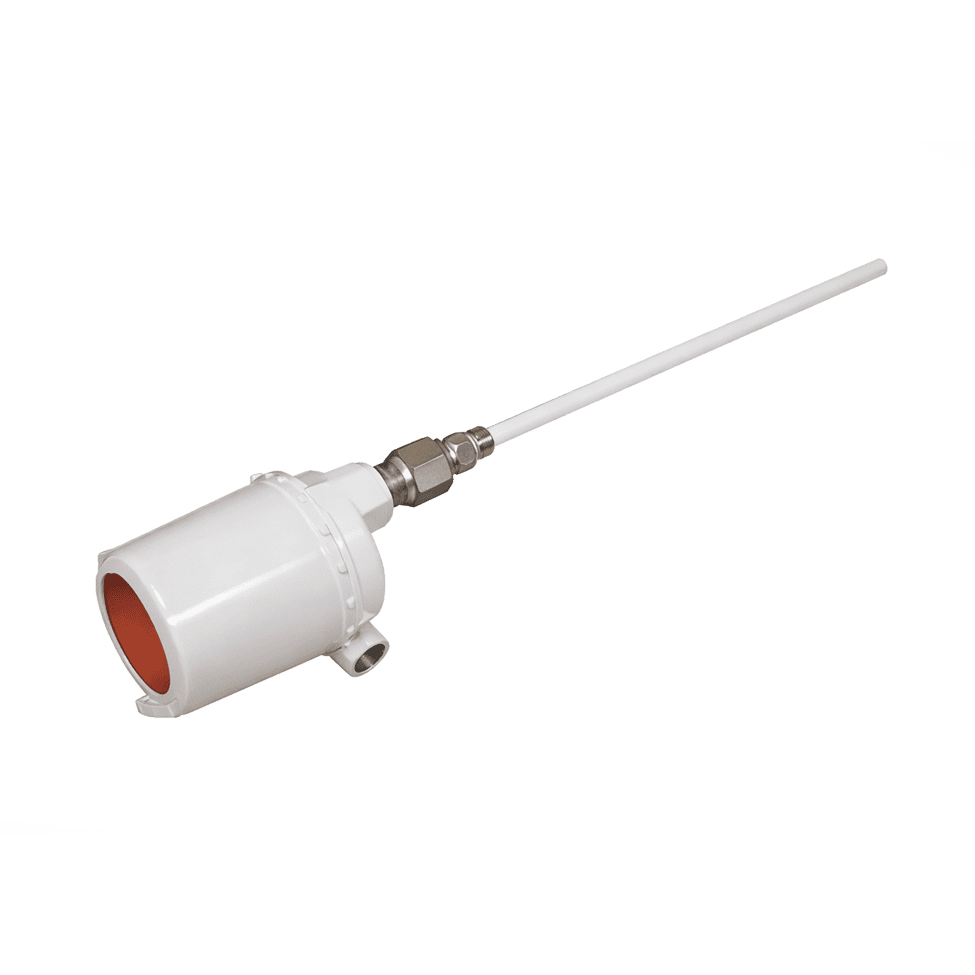
A capacitance level system consists of a sensing probe and electronics that energize the probe with a radio-frequency signal. As material rises or falls in the vessel, the change in dielectric between the probe and the tank wall alters the probe’s capacitance. The electronics interpret this shift and convert it into either a continuous analog output (4–20 mA or 0–10 VDC) for inventory and process control, or a discrete relay output for alarms, pump control, and safety interlocks.

The driven-guard electrode design is what separates industrial capacitance instruments from basic probes. A guard signal cancels the effect of product buildup on the probe sheath, rejecting coating conductivity up to 1,000 µmhos. This coating immunity, combined with adjustable time delays and fail-safe relay logic, allows capacitance devices to deliver stable, repeatable readings in materials that challenge mechanical or ultrasonic instruments, including viscous coatings, slurries, powders, and aerated liquids.

Installation is straightforward. Metallic vessels naturally supply the ground reference; non-metallic tanks use concentric or dual-probe assemblies. The probe threads into a standard nozzle, positioned away from fill streams and internal obstructions. Flexible cable probes extend up to 250 feet, and remote electronics can separate from the probe by up to 800 feet, making capacitance practical for deep vessels, tall silos, and hazardous locations where local access is restricted.

One selection variable to understand: the product’s dielectric constant (ε) determines measurement sensitivity. Materials with ε greater than 1.5 produce reliable readings. Very low-dielectric products such as dry powders or light hydrocarbons may require careful probe selection and calibration to maintain accuracy.

Continuous Transmitter vs. Point Switch

Cognesense’s capacitance portfolio includes two distinct instrument types. Cap-Analog transmitters (400 series) provide continuous analog level output for inventory monitoring, process control, and trending. Captrol switches (500 series) provide discrete relay outputs for point-level alarms, pump start/stop, and overfill protection.

When to Choose Capacitance Technology

Capacitance is the right technology when you need reliable level detection in challenging media or environments where mechanical and ultrasonic methods struggle:

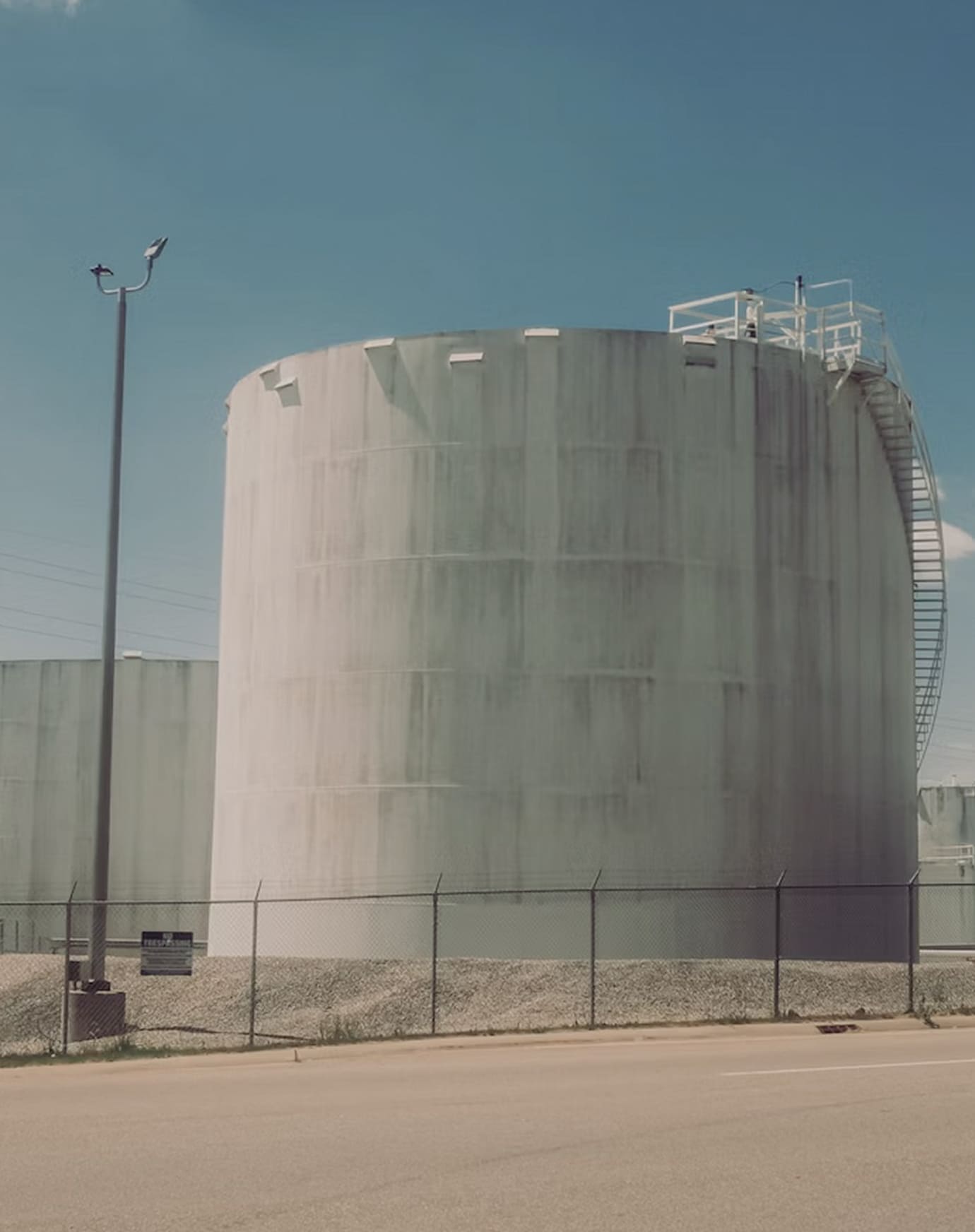
  • Small chemical and petroleum storage tanks handling viscous, coating, or conductive liquids.
  • Bulk Solids and Powder Silos such as cement, ash, grain, plastic pellets, and granular materials where mechanical floats and ultrasonic sensors are ineffective.
  • Wastewater Sumps and Pump Control when reliable pump start/stop and dry-run protection is required such as in wet wells, condensate receivers, and process sumps where buildup and turbulence are constant.
  • Food and Beverage Processing Ingredient storage, blending vessels, and process tanks where the probe’s solid-state construction eliminates contamination risk from moving parts.
  • Pressurized or High-Temperature Vessels Process vessels operating at pressures up to 400 psi and temperatures from −40 °F to 200 °F, where sealed probe construction maintains stable measurement.
  • Hazardous Locations (Class I & II) Explosion-proof installations in classified environments meeting NEMA 4, 5, 7, 9, 12 and NEC Class I Groups C & D / Class II Groups E, F, G requirements.
02

Why It Excels

01

Tanks with Heavy Coating, Buildup, or Product Adhesion

The driven-guard electrode actively cancels coating effects up to 1,000 µmhos conductivity, maintaining accurate readings where deposits cause false trips in other instruments.

02

Applications Spanning Liquids, Slurries, and Dry Solids

A single technology platform covers the full material spectrum from clean water to viscous coatings to cement powder, reducing the number of instrument types a facility must stock and maintain.

03

Vessels Requiring Long Probe Runs or Remote Electronics

Flexible cable probes reach 250 feet and remote preamp configurations separate electronics from the probe by up to 800 feet, serving deep tanks, tall silos, and locations where access is restricted.

04

Multi-Point Alarm Requirements from a Single Penetration

The Captrol 500 Series provides up to four independent setpoints from one probe, eliminating multiple tank nozzles and reducing vessel penetrations for sequencing or batching operations.

05

Installations with No Tolerance for Moving Parts

No floats, displacers, or mechanical linkages. The solid-state sensing element resists vibration, agitation, and pressure cycling without calibration drift.

06

Facilities Needing Both Measurement and Alarms from One Technology Family

Cap-Analog transmitters and Captrol switches share the same sensing principle, probe styles, and installation practices, simplifying training, spare parts, and maintenance across the plant.

03

Cap-Analog Transmitter vs. Captrol Switch

Attribute Cap-Analog 400 Series Transmitters Captrol 500 Series Switches  
Output type
Continuous analog (4–20 mA or 0–10 VDC) Discrete relay (DPDT), one to four setpoints  
Primary function
Inventory monitoring, process control, trending High/low alarms, pump control, overfill protection  
Number of outputs
One analog signal; some models add up to two relays One to four independent relay setpoints per probe  
Electronics location
Integral (410, 4100) or remote up to 800 ft (420, 421) Integral (500, 511) or remote up to 800 ft (520)  
Power options
115/230 VAC or 24 VDC (410); loop-powered 24 VDC (4100) 115/230 VAC or 24 VDC universal  
Maximum probe length
Up to 250 ft flexible cable; 19 ft rigid rod Up to 250 ft flexible cable; 19 ft rigid rod  
Which to choose
Use Cap-Analog transmitters when you need continuous level data for inventory, process feedback, or automation. Use Captrol switches when you need discrete point-level detection for alarms, pump control, or safety interlocks.  

What to Consider Alongside Capactive Technology

Consider an alternative when:

  • You need non-contact, maintenance-free measurement and the product’s dielectric constant is sufficient for reliable echo return. See Radar Level Gauges.
  • The application requires custody-transfer accuracy with density, interface, or BS&W measurement. See Servo Level Gauges.
  • The vessel stores clean liquids where a magnetostrictive float provides higher precision continuous measurement or interface detection or you have an underground storage tank. See Magnetostrictive Level Gauges.
  • You need only liquid-service point-level protection and prefer dielectric-independent switching. See Magnetostrictive Point Level Switches.

How this technology fits into a larger system:

Capacitance instruments often serve as the cost-effective measurement or switch layer in a smaller tank volume application.

  • Use FuelsManager® to collect Cap-Analog transmitter data alongside radar, servo, and float & tape measurements for centralized inventory and compliance reporting. See FuelsManager®.
03

Featured Products

01

Cap-Analog 420 — Remote Capacitance Transmitter

The most widely deployed capacitance instrument in the Cognesense portfolio. Pre-amplifier mounts at the probe while main electronics sit in a NEMA 4X enclosure up to 800 ft away. Analog output plus up to two independent relays with selectable high/low fail-safe modes.

02

Cap-Analog 4100 — Two-Wire Capacitance Transmitter

True two-wire loop-powered operation with up to one-mile separation between probe and control room via twisted pair. Reversible 4-20 mA output with probe lengths up to 250 ft.

03

Captrol 500 — Single-Point Capacitance Switch

Driven-guard probe design with adjustable time delay, universal power, and explosion-proof construction. Static suppression and LED indication standard.

Bottom section image
Measure.
Monitor.
Protect.