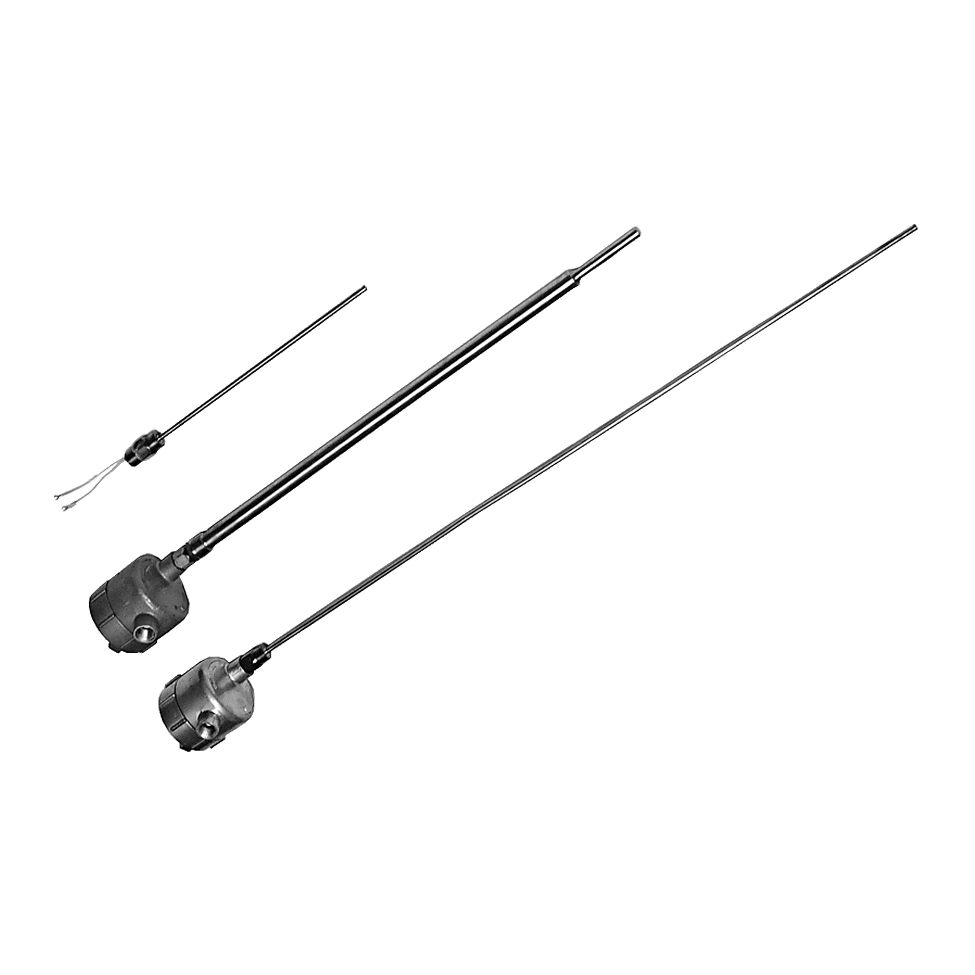
Temperature probes measure the product temperature inside a storage tank using platinum RTD (Resistance Temperature Detector) elements. As temperature changes, the electrical resistance of the platinum element shifts by a precise, repeatable amount, and the probe’s electronics convert that shift into a calibrated temperature reading. This temperature value is the second essential input, alongside level, for calculating corrected inventory volumes under API MPMS and OIML standards.
Cognesense offers two approaches. A spot temperature probe uses a single high-accuracy RTD to measure temperature at a single fixed depth. An average temperature probe uses multiple RTD elements spaced vertically through the product column. When paired with the MCG 2350 Average Temperature Converter, these elements are automatically scanned, the system identifies which RTDs are submerged and excludes vapor-space elements and then calculates a true weighted average. The result is an API-compliant average product temperature even in tall tanks with significant stratification.
Built for demanding tank-farm environments, Cognesense probes use stainless-steel housings, armored flexible hoses, spring-loaded thermowells, and wide operating-temperature ranges. Installation involves mounting the probe through a flanged nozzle or thermowell, so the sensing elements extend into the product column. Spot probes thread into a single nozzle; average probes run the full tank height. Both integrate directly with servo, radar, and float & tape gauges for digitized data transmission.
One variable that newcomers to the petroleum industry should understand: every petroleum product expands and contracts with temperature. Without accurate temperature input, volume corrections (VCF/CTL) cannot be applied, and inventory figures, custody-transfer settlements, and mass-balance reports will contain systematic errors.
A spot probe captures temperature at one depth, providing a simple, rugged, low-cost measurement suitable for thermally uniform or small tanks. An average probe captures temperature at multiple heights and calculates a representative average, which is required for large tanks, custody-transfer applications, and any vessel with significant temperature layering. Spot probes are chosen for simplicity; average probes are chosen for accuracy in stratified conditions.
Choose a spot probe for uniform products, small vessels, or pressurized tanks. Choose an average probe when custody-transfer standards or temperature stratification demand multi-point measurement.
Temperature probes are required whenever accurate inventory, custody transfer, or volume correction depends on knowing the product temperature:
Platinum RTD elements deliver ±0.1 °C accuracy with factory calibration traceable to international standards, providing the temperature precision that custody-transfer volume corrections demand.
Multi-element probes automatically identify submerged RTDs and exclude vapor-space elements, delivering a true weighted average rather than a single-point approximation.
Stainless-steel construction, armored hoses, and spring-loaded thermowells withstand corrosive products, high pressures, and wide temperature ranges without calibration drift.
No moving parts, no consumables, and no recalibration drift. RTD probes deliver stable performance across years of continuous service.
Direct digital integration with servo, radar, and float & tape gauges eliminates separate wiring runs and provides a unified data path from tank to control room.
Consider an alternative when:
Single-element platinum RTD for point temperature measurement in uniform or pressurized tank applications.
Multi-element RTD probe capturing temperature at multiple heights for representative average measurement.
Signal processing unit that scans, validates, and averages MCG 351 probe elements for API-compliant temperature output.