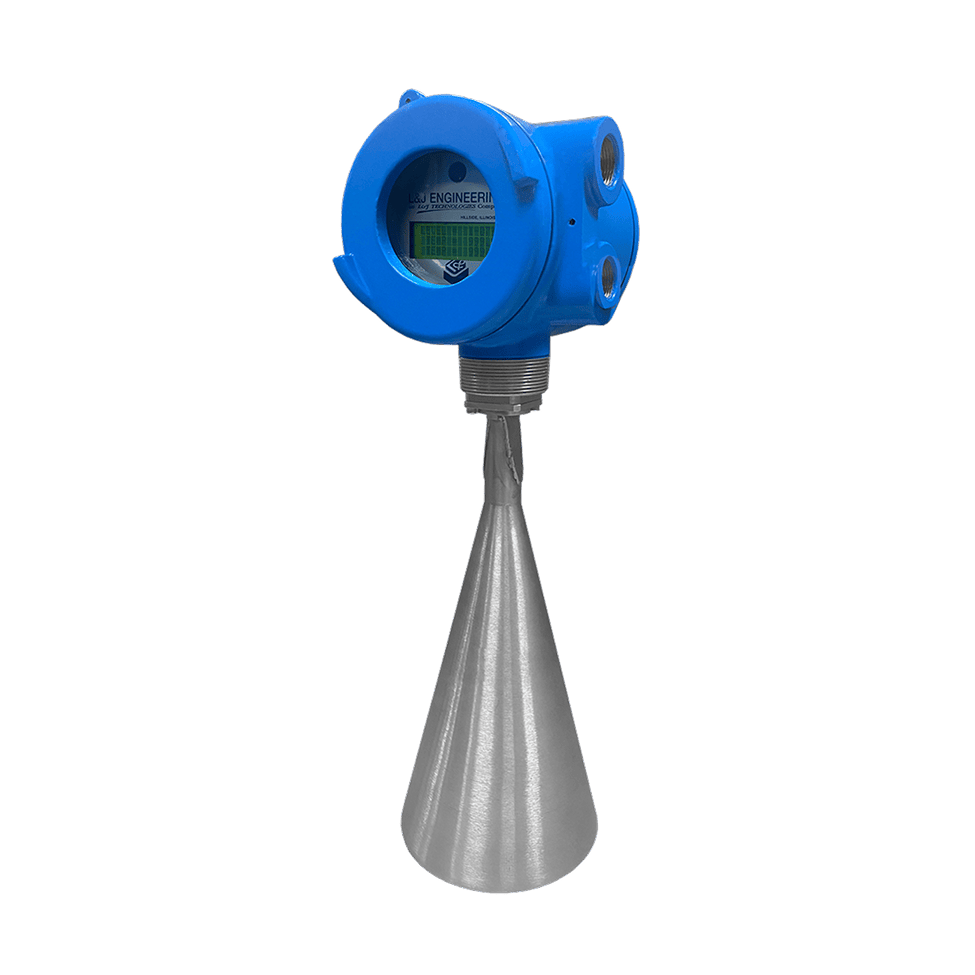
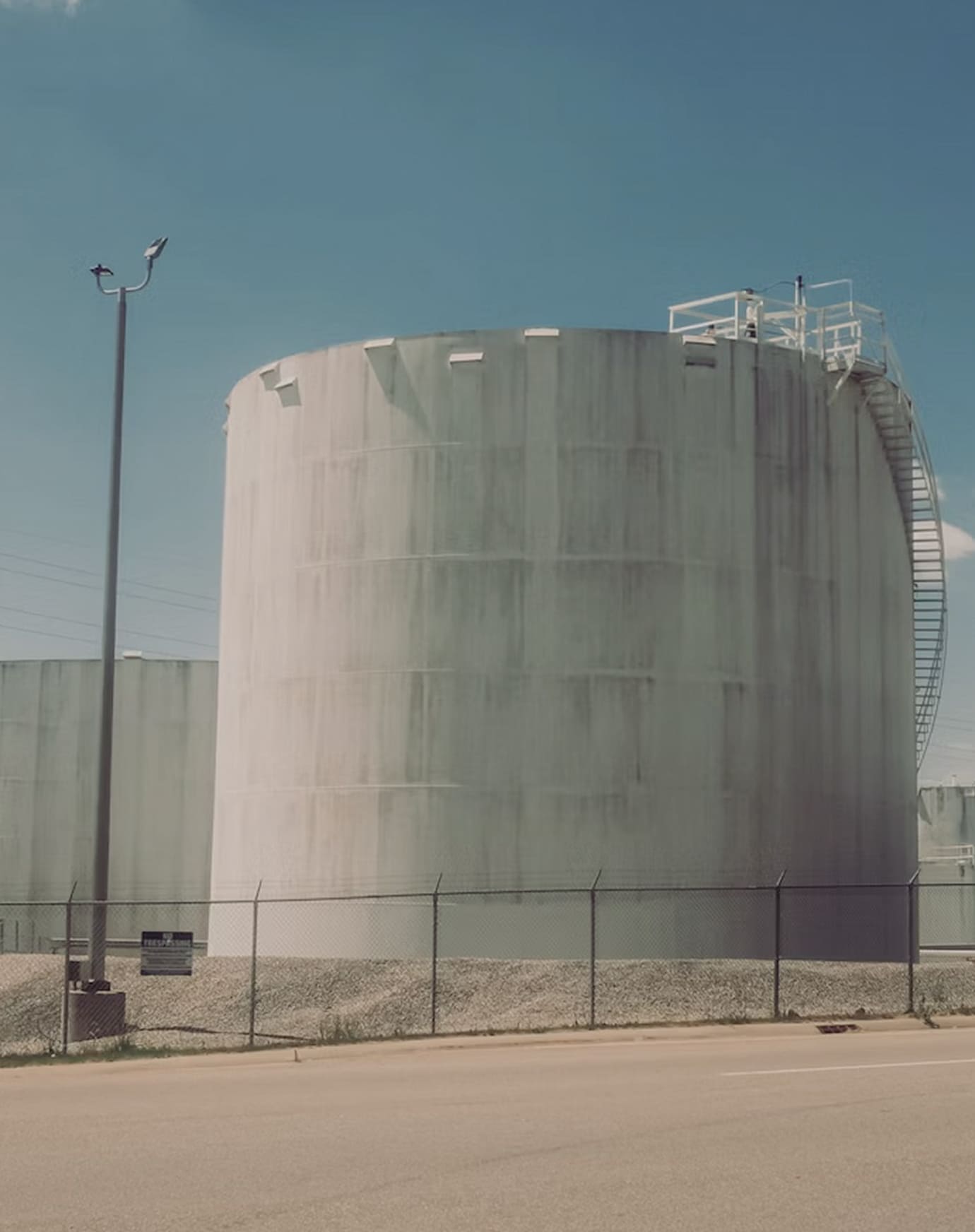
Radar level gauges measure liquid or solid level without touching the product. A transmitter mounted on the tank roof sends microwave energy downward through the vapor space; the signal reflects off the liquid surface and returns. The gauge calculates the liquid level from the frequency shift or timing of the returning echo, delivering continuous measurement with no mechanical contact.
Cognesense’s radar portfolio uses FMCW (Frequency-Modulated Continuous Wave) technology, which continuously compares the emitted and reflected signal frequencies, achieving accuracy of ±0.5 mm. FMCW has largely replaced older pulse radar in precision tank gauging. Because nothing contacts the product, radar eliminates contamination risk, resists coating and buildup, and maintains reliable measurement through foam, condensation, vapor layers, and temperature extremes.
Installation centers on selecting and placing the antenna. The transmitter mounts vertically on a tank nozzle or stilling well, positioned away from walls, internal obstructions, and filling streams. Various antennas produce wider or narrower beam angles, improving signal focus in tall tanks or signal strength in challenging environments. Stilling-well antennas guide the signal in a contained path for applications where open vapor spaces create excessive signal noise.
One selection variable newcomers should understand: the product’s dielectric constant affects signal strength. High-dielectric liquids such as water and acids produce strong signal returns; low-dielectric hydrocarbons like LPG and light naphtha may require larger antennas or stilling wells to maintain reliable measurement.
Radar and servo gauges are not interchangeable. Radar measures the level through the vapor space without contacting the product, making it ideal where low maintenance and broad application flexibility are priorities. Servo gauges lower a displacer into the liquid and mechanically measure level, density, and interface, providing data that radar cannot capture. Many custody-transfer installations use both: servo as the primary fiscal instrument, and radar as the independent verification.
Choose servos when level measurement as well as density, BS&W, or interface detection drives the requirement.
Choose radar for maintenance-free non-contact level measurement.
Radar is the right primary technology when non-contact measurement, low maintenance, and broad application flexibility drive the decision.
Non-contact measurement operates through what fills the vapor space, with no mechanical parts to foul or corrode.
No moving parts, no consumables, no recalibration drift. Radar gauges can operate for years without maintenance.
A single radar model handles fuels, chemicals, crude, and water without reconfiguration when products change.
Sealed antenna assemblies operate across wide temperature and pressure ranges without process seals or moving components.
Loop-powered and stilling-well-compatible radars mount into existing tank infrastructure, preserving installed fittings and wiring paths.
Radar provides a technology-diverse second measurement alongside contact-based primary gauges, satisfying dual-measurement principles in API 2350 and OIML R85 frameworks.
| Attribute | L&J evo 1610 | L&J MCG 1600SFI | L&J evo 2600 |
|---|---|---|---|
|
Core role
|
Custody transfer & fiscal measurement | Process-grade with native I/O flexibility | General inventory & retrofit |
|
Accuracy
|
±0.5 mm (OIML R85 certified, NMi verified) | ±0.5 mm | ±3 mm |
|
Range
|
Up to 26 m (85 ft) | Up to 55 m (180 ft) | Up to 20 m (65 ft) |
|
Frequency
|
10 GHz | 10 GHz | 26 GHz |
|
I/O & protocols
|
Requires MCG 1650 Smart Core for analog I/O and Modbus | Built-in relays, analog I/O, multi-protocol — no additional modules needed | Loop-powered, simple integration |
|
Antenna options
|
Conical horn, stilling-well, 15″ parabolic (316 SS) | Parabolic, conical, rod, stilling-well — broadest selection | Compact horn |
|
Best suited for
|
Refineries, fuel terminals, chemical storage, ethanol | Crude, asphalt, LPG/LNG, cryogenics, solids — diverse and retrofit applications | Utilities, wastewater, bulk liquids, float & tape replacement |
|
Which radar for which situation?
|
|
|
|
Consider an alternative when:
OIML R85-certified FMCW radar with ±0.5 mm accuracy for fiscal measurement and regulated product accounting.
FMCW radar with integrated relays, analog I/O, and multi-protocol support for diverse products and retrofit installations.
26 GHz FMCW radar delivering ±3 mm accuracy with intuitive setup for everyday inventory and mechanical gauge replacement.