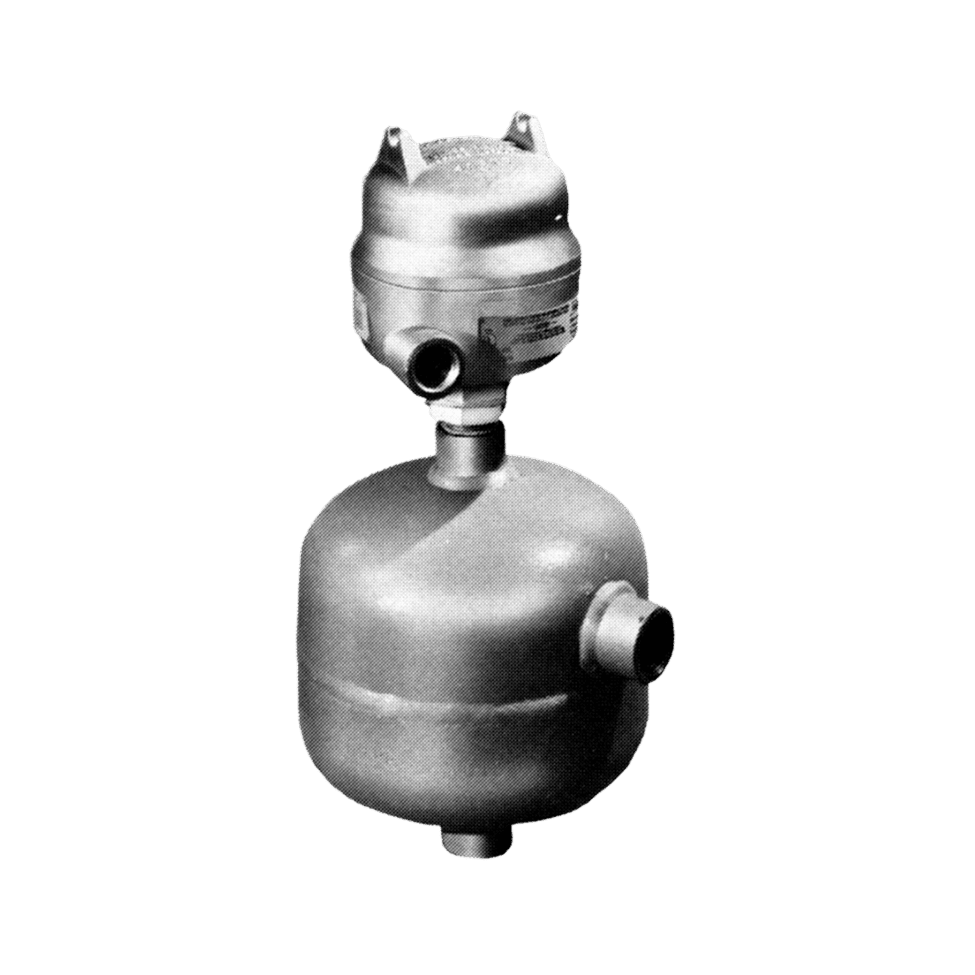
Omnitrol 666/668 (C)
Omnitrol 664/666/668 (F)
Omnitrol 663/664/666/668 (W)
Omnitrol 764/766/768 (F)
Omnitrol 764W/766W/768 (W)
01

Chamber Mount Level Control Switches

Omnitrol: 666/668 (C), 664/666/668 (F), 663/664/666/668 (W), 764/766/768 (F), 764W/766W/768 (W)
Fail-safe alarms with in-line isolation.

What It Is & How It Works

A chamber mount level control switch is a mechanical point-level instrument that uses buoyancy to trigger an electrical switch at a preset liquid level. Unlike top-mount designs that install through a tank-top nozzle, chamber mount switches operate inside a pressure-rated external chamber connected to the vessel through side nozzles. This arrangement allows the instrument to be valved off and serviced without draining the tank or entering the vessel.

The operating cycle is purely mechanical. A displacer hangs on a spring-loaded rod inside the sealed chamber. As liquid enters through the side connections and reaches the displacer, buoyant force lifts the assembly against the spring. A permanent magnet coupled to this movement actuates a snap-action SPDT or DPDT microswitch through magnetic coupling, with no moving parts penetrating the process boundary. Factory calibration to the process specific gravity sets the correct actuation point and switching differential.

Chamber mount switches connect to the vessel through various connections, usually 1” NPT connections, positioning the displacer at the required detection point. Isolation valves allow removal for inspection, recalibration, or replacement while the vessel remains in service. Dual-actuator models house two independent switching mechanisms in a single chamber, providing both high and low alarm points or pump start/stop control from one installation.

Displacer material and chamber length determine application range. Standard graphite displacers handle petroleum and chemical services at specific gravities as low as 0.45. Long-body welded or flanged chambers extend the differential range and enable interface detection between two liquids of different density.

Chamber Mount vs. Top Mount Switch

Chamber mount and top mount level control switches use the same buoyancy-driven displacer principle but install differently. Top mount switches drop through a single tank-top nozzle, requiring no side connections. Chamber mount switches install through side nozzles in a pressure-rated external bypass, allowing the instrument to be isolated and serviced without opening the vessel. Choose top mount for simple top-entry installations and electronic high level alarm applications. Choose chamber mount when you need in-line isolation, high-pressure service, or dual-point detection.

When to Choose Chamber Mount Level Control Switches

Chamber mount switches are selected when serviceable isolation, pressure capability, and precise switching on demanding liquids drive the decision:

  • Refinery Heaters, Separators & Steam Drums High-level and low-level alarms on high-pressure, high-temperature vessels where electronics in the wetted path are impractical.
  • Low Specific Gravity Hydrocarbons (LPG, NGLs, Light Solvents) Factory-set displacers deliver small, predictable switching differentials at low SGs, minimizing nuisance trips on light products.
  • Pressurized Vessels Requiring In-Line Service Side-mounted chambers with isolation valves allow maintenance without depressurizing or draining the vessel.
  • Oil/Water Interface Detection in Separators Long-body welded or flanged chambers can be factory-set for two-phase duty, detecting the interface between liquids of different density.
  • Dual-Point Pump Control Dual-actuator models provide independent start/stop or HI/LO set points from a single chamber installation, reducing nozzle count and wiring.

Why Chamber Mount Switches Excel

01

High-Pressure and High-Temperature Process Vessels

Pressure-rated external chambers maintain reliable mechanical switching in conditions common to refining, chemical processing, and power generation.

02

Low Specific Gravity Services

Published switching differentials at low SGs provide predictable, repeatable alarm points on light hydrocarbons and solvents.

03

Facilities Requiring Maintenance Without Process Shutdown

Isolation valves on the chamber nozzles allow the instrument to be removed, inspected, and recalibrated while the vessel stays in service.

04

Applications Needing Two Independent Set Points in One Location

Dual-actuator chamber designs deliver HI/LO alarms or pump start/stop from a single installation, simplifying piping and wiring.

05

Turbulent, Foaming, or Coating-Prone Process Fluids

Weighted displacers and snap-action switching deliver chatter-free alarm points in agitated or difficult services.

06

Hazardous Classified Locations

Explosion-proof and vapor-proof housings with UL/CSA approvals meet compliance requirements for Class I and II, Division 1 areas.

03

Choosing the Right Chamber Mount Switch

Attribute Compact Single-Point (C Series) Standard Single-Point (F & W Series) Dual-Point (764 Series)
Models
666C / 668C 664F / 666F / 668F (flanged); 663W / 664W / 666W / 668W (welded) 764F / 766F / 768F (flanged); 764W / 766W / 768W (welded)
Detection points
Single Single Two independent set points
Chamber construction
Short form welded, compact body Standard-length flanged or long welded body Standard-length flanged or long welded body
Interface detection
No Yes (long-body W and F models, factory-set for two-phase duty) No (This is dual-point, not interface)
Chabmer options
Welded only Flanged (F) for process piping connections; welded (W) for permanent high pressure installations Flanged (F) or welded (W), matching the site piping configuration and desired service
Low-SG performance
Excellent; designed for tight differentials on light hydrocarbons Published differentials across a wide SG range Published differentials across a wide SG range
Typical application
Low-SG alarms in tight spaces; steam condensate; light solvents Process vessels, bypass chambers, and separator interface duty Pump start/stop control; HI/LO alarm pairs from one chamber
Key advantage
Smallest footprint in the portfolio Broadest application range with flanged or welded connection options Eliminates a second chamber and nozzle pair for dual-point applications
Choose this when…
You need a compact, single-point alarm on low-SG liquids or in space-constrained piping. You need a versatile single-point switch with flanged process connections, long-body interface capability, or welded permanent installation. You need two independent alarm or control points from one chamber, reducing nozzle count and installation cost.

What to Consider Alongside Chamber Mount Switches

Consider an alternative when:

How chamber mount switches fit into a larger system

  • Pair chamber mount switches with servo or radar level gauges to create independent alarm layers for API 2350 overfill prevention, where the switch operates on a separate sensing principle from the primary gauge. See Servo Level Gauges or Radar Level Gauges.
  • Connect switch relay outputs to Varec FuelsManager® or facility SCADA for centralized alarm management, automated logging, and compliance reporting across multi-tank installations. See FuelsManager®.
  • Combine with Shand & Jurs conservation vents and flame arresters for a complete tank safety system covering level alarms, pressure/vacuum protection, and vapor control. See Conservation Vents.
04

Featured Products

01

Omnitrol 666C/668C

Compact chamber-mounted displacer switching for low-SG hydrocarbons, light solvents, and steam condensate.

02

Omnitrol 664F/666F/668F

Flanged chamber displacer switching with factory SG calibration for pressurized vessels and bypass chambers.

03

Omnitrol 764/766/768W

Welded chamber dual-actuator displacer switching for independent pump control and HI/LO protection from a single chamber.

Bottom section image
Measure.
Monitor.
Protect.