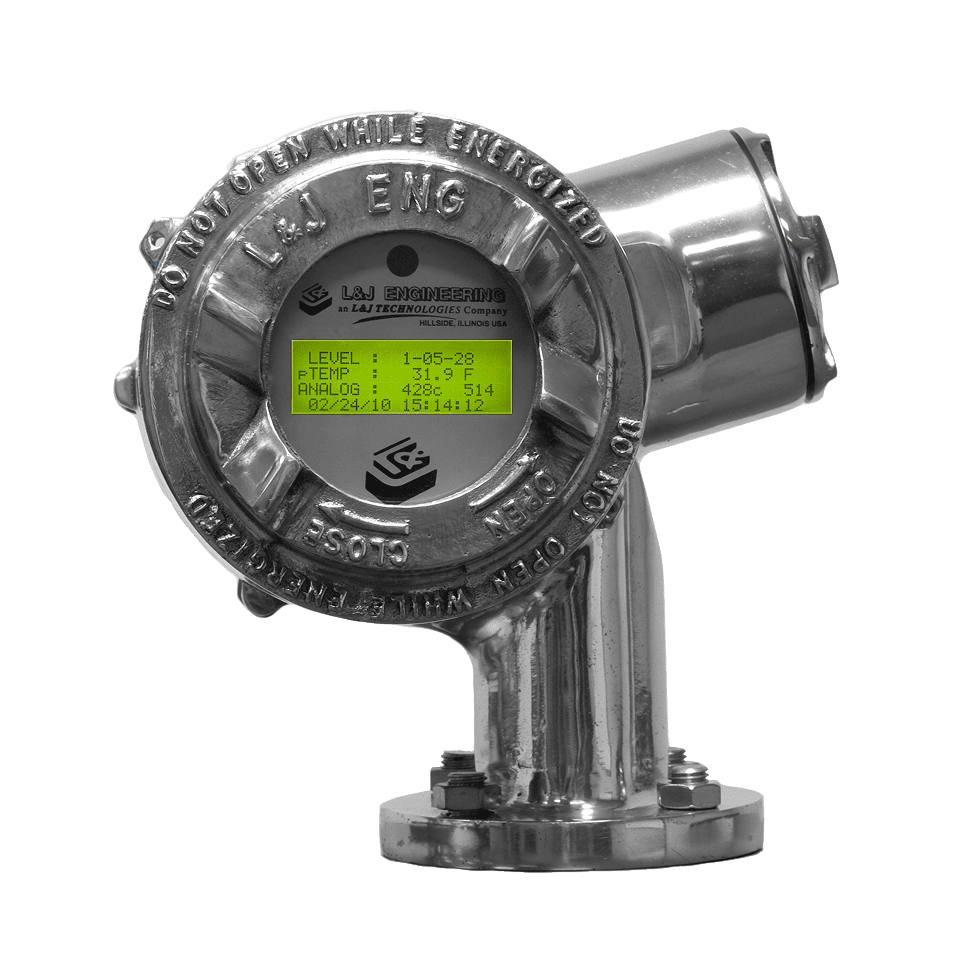
MCG 1500SFI
01

Servo Level Gauge

MCG 1500SFI
Precision level, interface, and density measurement.

What It Is & How It Works

A servo level gauge lowers a small displacer into the tank on a stainless-steel wire. As the displacer contacts liquid, buoyant force reduces its apparent weight and the gauge’s servo motor continuously repositions it to stay at the liquid surface. By precisely measuring the change in force and the displacer position, the system determines the product level, the water-bottom interface, and the liquid density from a single instrument.

Because servo gauges measure buoyancy rather than dielectric contrast or reflected signals, they perform consistently regardless of vapor conditions, foam, emulsions, or low-dielectric hydrocarbons. This direct mechanical reference to the liquid surface is why servo technology remains the standard for custody-transfer and fiscal measurement. Typical accuracy reaches ±0.4 mm with ±0.1 mm sensitivity.

Cognesense servo gauges use a magnetic coupling to isolate the measuring chamber from the electronics and modular assemblies that enable in-field repair, in-field electronics upgrades, and ground-level infrared calibration without opening the explosion-proof housing, even in Class I Division 1 environments.

Servo Gauge vs. Radar Gauge

Both technologies measure liquid level in storage tanks, but they work on fundamentally different principles. Radar gauges transmit a microwave signal and calculate level from the reflected echo, a non-contact method with no moving parts and minimal maintenance. Servo gauges lower a physical displacer into the liquid and measure buoyancy forces directly, providing mechanical traceability plus density, interface, and BS&W from one device.

Choose radar for maintenance-free non-contact level measurement.

Choose servos when level measurement as well as density, BS&W, or interface detection drives the requirement.

When to Choose a Servo

Servo level gauges are selected when traceability, metrological integrity, and auditable accuracy drive the decision:

  • Custody-Transfer Storage Tanks where legal metrology or fiscal measurement is required under OIML R85, API MPMS, or ISO 4266.
  • Petroleum & Chemical Terminals Refined products, crude oil, additives, and multi-product tank farms requiring certified inventory accuracy.
  • High-Pressure or Liquefied Gas (LPG/LNG) Tanks Pressurized or cryogenic vessels where signal-based measurement methods are limited and mechanical traceability is required.
  • Density, Interface & BS&W Measurement Multi-phase products where bottom sediment and water measurement, interface detection, or density profiling determines product quality and settlement.
  • Refineries, Tank Farms & Blending Operations Inventory management, loss control, and blending accuracy where certified measurement underpins financial reconciliation.
MCG 1500SFI
MCG 1500SFI
02

Why It Excels

01

Custody-Transfer and Fiscal Metering

Direct mechanical reference to the liquid surface provides traceable, auditable accuracy independent of product type or vapor conditions.

02

Applications Requiring Simultaneous Level, Density, and Interface Data

Measures level, density, interface position, and BS&W from one device, reducing tank penetrations and instrumentation complexity.

03

Heavy Foam, Emulsion, or Low-Dielectric Environments

Buoyancy-based measurement is unaffected by dielectric constant, surface turbulence, or heavy vapor conditions that can challenge alternate technologies and methods.

04

High-Pressure and Cryogenic Vessels

Sealed displacer design handles pressure and temperature extremes, maintaining stable mechanical accuracy across a wide operating envelope.

05

Facilities Requiring Minimal Downtime for Maintenance and Calibration

Modular electronics allow in-field repairs, in-field upgrades, and remote infrared calibration without opening the housing or climbing the tank.

What to Consider Alongside Servo Level Gauges

Consider an alternative when:

  • You need non-contact, low-maintenance measurement and do not require density or interface data. See Radar Level Gauges.
  • The application is general inventory on non-custody tanks where ±3 mm accuracy is sufficient. See Radar Level Gauges.
  • The tank is small, underground, or requires flexible probe installation. See Magnetostrictive Level Gauges.
  • You need only point-level alarms, not continuous measurement. See our Level Alarms.

How servo gauges fit into a larger system

  • Servo + Radar for dual-measurement verification. Custody-transfer standards (OIML R85, API MPMS, ISO 4266) emphasize independent verification of primary level readings. Pairing a servo gauge with an L&J evo2600 FMCW radar creates a redundant architecture where the servo provides the traceable custody reference and radar delivers continuous non-contact confirmation. See Radar Level Gauges.
  • Servo + Level Switches for overfill protection. Independent high-level alarm probes (L&J MCG 1090/1095) create an API 2350-compliant safety layer that operates independently of the continuous level measurement. Level Alarms.
  • Servo + Varec FuelsManager® for inventory intelligence. Servo gauge data feeds directly into FuelsManager for real-time volume correction, tank strapping, custody-transfer reporting, and automated compliance across the tank farm. See FuelsManager®.
04

Featured Product

01

L&J Technologies MCG 1500 SFI Servo Gauge

Custody-grade level, density, interface, and BS&W measurement with ±0.4 mm accuracy from a single instrument.

Bottom section image
Measure.
Monitor.
Protect.