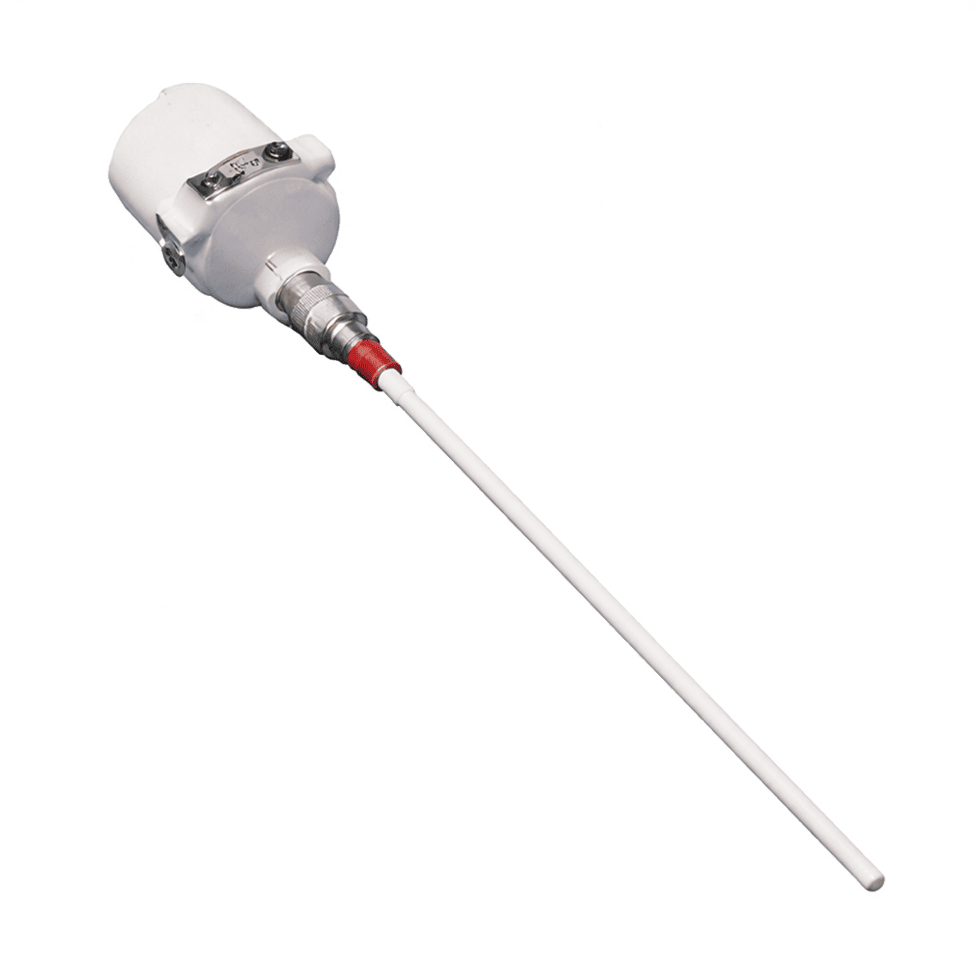
The Cap Analog 4100 is designed for process engineers, instrumentation specialists, and plant operators who require accurate, maintenance-free, and intrinsically safe continuous level measurement across liquids, slurries, or bulk solids.
The transmitter uses two-wire RF capacitance technology with loop-powered 4–20 mA output and a compact explosion-proof design for simple installation and long-term reliability.
Unlike traditional transmitters that require frequent recalibration or suffer from coating buildup and dielectric drift, the Cap Analog 4100 incorporates independent zero and span calibration, coating-rejection circuitry, and temperature-stable electronics, ensuring dependable accuracy even in demanding process environments.
With universal probe materials, wide capacitance range selection, and loop-powered simplicity, the Cap Analog 4100 provides high-performance level measurement for chemical, food and beverage, wastewater, and bulk storage applications while maintaining a low total cost of ownership.
The Cap Analog 4100 measures small changes in dielectric constant between the probe and tank wall and converts them into a stable analog output signal.
The loop-powered two-wire design eliminates the need for separate power wiring, reducing installation time and complexity. This makes the transmitter well suited for retrofit installations or remote tank sites.
All electronics are contained in a cast-aluminum explosion-proof enclosure rated for NEMA 4, 4X, 7, and 9 environments. The integral amplifier and temperature-compensated circuitry deliver long-term measurement stability, while coating-rejection electronics prevent false readings caused by buildup or sticky materials.
Four selectable capacitance ranges allow a single transmitter to cover a wide range of applications, from light hydrocarbons and slurries to powders and granular solids.
Field calibration is simple using 15-turn zero and span potentiometers, with built-in test points and an invert switch to simplify signal verification.
The Cap Analog 4100 connects easily to PLC and SCADA systems through a standard 4–20 mA output. It can also be paired with Delevan AFI-150 or DFI-150 field indicators for local or remote level display.
Simplifies wiring, reduces installation costs, and enables quick retrofit into existing control loops.
Provides continuous, drift-free level sensing in liquids, slurries, and solids with minimal maintenance.
Certified for Class I Division 1 and Class II Division 1 hazardous areas, making it safe for petroleum and chemical environments.
If you have questions that are not covered here, please contact the Cognesense support team for assistance.
Contact Us ↵
It uses a two-wire loop-powered design with temperature-stable electronics and coating-rejection circuitry, providing drift-free, low-maintenance measurement.
The primary benefit is reduced wiring cost and complexity. The Cap Analog 4100 draws its power directly from the 4–20 mA signal loop, eliminating the need to run separate power supply cables. This simplifies installation and reduces both the material and labor costs for new and retrofit projects.
Yes. The 4100 features an explosion-proof aluminum housing certified for Class I Div 1 and Class II Div 1 environments.
Operators can use independent zero, span, and calibration potentiometers for quick field tuning, with DIP switches for range selection and an invert option for signal direction.
Absolutely. The standard 4–20 mA output integrates easily with process control and monitoring systems.
Probes are offered in 316 SS, Teflon®, Kynar®, and Halar®, available as rigid rods or flexible cables to suit liquids, slurries, and solids.
The built-in coating-rejection circuit filters out noise from viscous or sticky materials, maintaining consistent accuracy.
The transmitter is designed with a specific probe and circuitry that measures the change in capacitance when the product level changes. The circuitry is able to electronically ignore the capacitance caused by a thin layer of conductive buildup on the probe (1,000 µmho), ensuring the measurement remains stable and accurate despite sticky media.
Yes. The Cap Analog 4100 is versatile enough to be used for level monitoring of bulk solids and granular materials. Unlike other technologies, the RF capacitance principle provides a continuous measurement that is generally not affected by dust or bridging of the material.