01

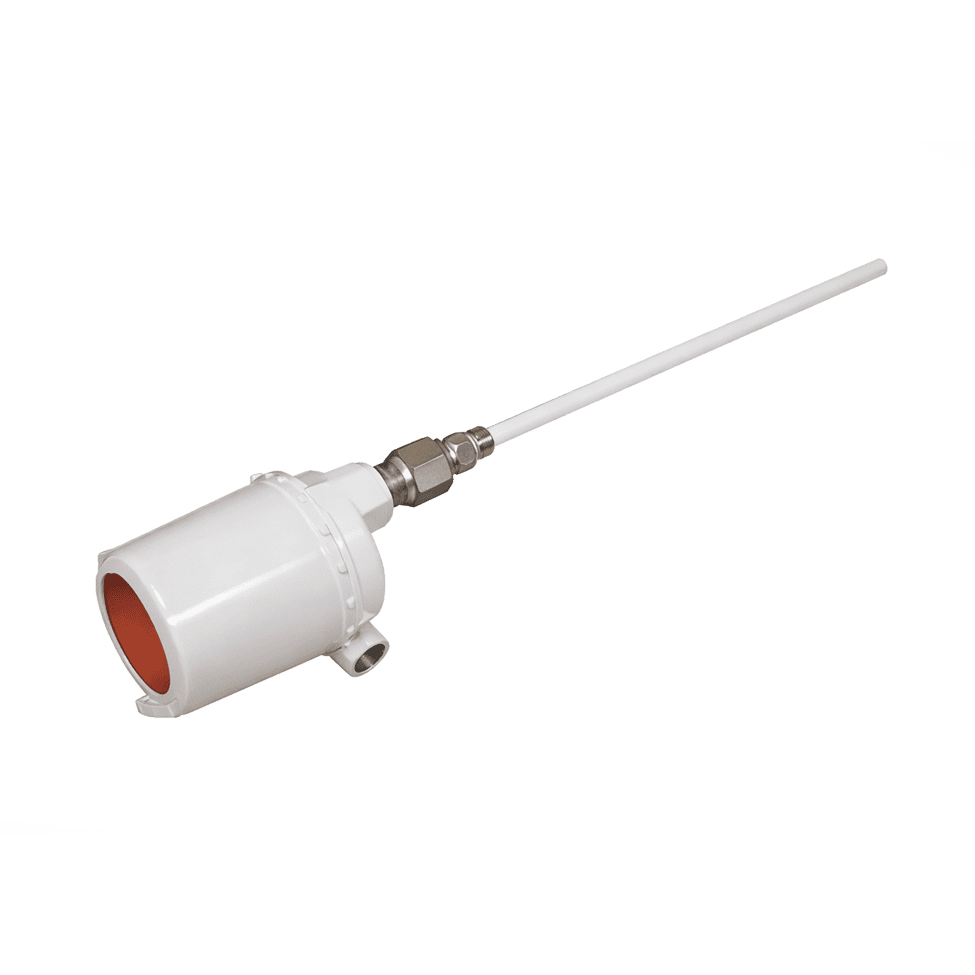
Cap Analog 410

RF Capacitance Level Transmitter

Get a Quote

Cap Analog 410

The Cap Analog 410 is designed for process engineers, plant operators, and instrumentation specialists who require a continuous, reliable, and cost-effective level transmitter for liquids, slurries, or bulk solids in chemical, food processing, and wastewater facilities.

The transmitter delivers proven RF capacitance measurement technology in a rugged, explosion-proof design.

Unlike conventional transmitters that may drift, foul, or lose accuracy over time, the Cap Analog 410 integrates shielded amplifier circuitry, coating-rejection electronics, and independent zero/span calibration. This ensures stable analog output and long-term reliability in demanding environments.

With analog output options (4–20 mA or 0–10 V DC), a universal power supply, and probe options up to 250 ft (76 m) in length, the Cap Analog 410 is suitable for storage tanks, process vessels, silos, and sumps. It provides maintenance-free measurement across a wide dielectric range, from light hydrocarbons to conductive slurries.

Cap Analog 410
Cap Analog 410 RF Capacitance Level Transmitter
Cap Analog 410

Features

RF Capacitance Sensing

Detects minute dielectric changes with stable conversion electronics, ensuring accurate level measurement across liquids, slurries, and powders without drift or false signals.

Explosion-Proof Electronics

Integral cast-aluminum enclosure meets hazardous-area requirements, enabling safe installation in Class I Div 1 environments without additional protective housing.

Independent Zero & Span

Non-interactive 20-turn controls allow operators to fine-tune calibration with precision, maintaining long-term signal stability across changing process conditions.

Wide Dielectric Capability

Handles 10–10,000 pF ranges, supporting reliable measurement in hydrocarbons, conductive slurries, chemical mixtures, and variable-DK process media.

Coating Rejection Circuit

Compensates automatically for viscous buildup on the probe, reducing cleaning requirements and maintaining accuracy in sticky or fouling applications.

Universal Power Flexibility

Accepts 115/230 VAC or 24 VDC inputs, simplifying installation across mixed facilities and eliminating the need for special-purpose power supplies.

Applications

  • Viscous Liquid Tanks: RF capacitance tolerates coating and buildup on probes, maintaining stable level measurement when other technologies drift or fail in sticky fluids.
  • Bulk Powder Silos: Non-mechanical sensing avoids wear, hang-ups, or false readings, providing reliable feedback for solids stored in tall silos or hoppers.
  • Hazardous Area Vessels: Explosion-proof housing supports compliant installation in Class I Div 1 zones, ensuring safe operation around flammable vapors and volatile products.
  • Chemical Processing Tanks: Wide dielectric capability allows accurate tracking of variable-composition chemicals, slurries, and process mixtures under changing operating conditions.
  • Remote or Deep Wells: Long probe lengths up to 250 ft enable reliable level detection in pits, deep wells, sumps, or large vertical tanks where other sensors cannot reach.
  • Wastewater & Sludge Systems: Coating-rejection circuitry maintains measurement accuracy in sludge, aerated liquids, and settling basins where fouling rapidly degrades conventional devices.
02

Specifications

Measurement Technology

RF Capacitance, integral electronic amplifier in cast aluminum housing

Output Signal

4–20 mA DC (isolated) or 0–10 V DC

Power Supply

115 VAC (90–135 V), 230 VAC (180–279 V), or 24 V DC (15–28 V)

Power Consumption

< 3 VA

Frequency

50–60 Hz

Temperature Range (Electronics)

–40 °F to +160 °F (–40 °C to +71 °C)

Zero Adjustment Range

10 – 2,000 pF (standard); extended with DIP switches

Span Range

Low range 50–1,000 pF; high range 800–10,000 pF

Stability

±0.5 pF per 30 °F (max sensitivity)

Build-Up Tolerance

Up to 1,000 µmho conductivity coating

Probe Options

Teflon (T), Kynar (K), Stainless Steel (BF), Heavy-Duty Dual (TCDD/KHDD) types; lengths to 250 ft

Mounting

¾″ NPT standard; flange or Tri-Clover sanitary options

Enclosure Rating

Cast Aluminum with polyester finish; NEMA 4, 5, 7, 9, 12; CSA and NEC Class I Groups C, D; Class II Groups E, F, G

Coating Rejection

Approx. 1,000 µmho built-in

Accessories

Delavan AFI-150 / DFI-150 field indicators, remote displays, and mounting hardware

Contact Support
2026 COST ESTIMATE

Contact Support

If you have questions not covered here, please contact the Cognesense support team for assistance.

Contact Us

What measurement technology does the Cap Analog 410 use?

It uses RF capacitance technology to convert dielectric changes between a probe and reference ground into a continuous analog signal.

Is the Cap Analog 410 suitable for hazardous environments?

+

Yes. Its cast-aluminum, explosion-proof housing meets NEMA and CSA/NEC Class I Div 1 and Class II Div 2 standards.

How is the transmitter calibrated?

+

Independent zero and span adjustments allow quick, precise field calibration without interaction or drift.

Can it measure sticky or viscous materials?

+

Yes. The built-in coating rejection circuit maintains accuracy even with buildup on the probe.

How does it handle buildup or coating on the probe?

+

The Cap-Analog 410 uses a specialized shielded amplifier and coating rejection circuit. This advanced design is able to differentiate between the capacitance of the actual product level and the capacitance caused by buildup (up to 1,000 µmho conductivity coating) on the probe, ensuring the reported level remains stable and accurate.

What power supply options are available?

+

It supports 115 VAC, 230 VAC, or 24 V DC inputs, making it universally compatible with plant standards.

What probe types are offered?

+

Teflon®, Kynar®, and stainless-steel probes are available for chemical, food-grade, or high-temperature service.

Can it be used with both conductive and non-conductive liquids?

+

Yes. The device features a wide dielectric range of 10 – 10,000 pF, making it highly versatile. It can accurately measure light, non-conductive hydrocarbons (low dielectric) as well as conductive liquids, slurries, and water-based solutions (high dielectric).

What advantages do independent zero and span adjustments provide?

+

Independent Zero and Span adjustments allow field technicians to precisely set the minimum (Zero) and maximum (Span) output signals without one adjustment affecting the other. This significantly simplifies the calibration process, especially when commissioning in the field, reducing errors and saving time.

Summary

With over 100 years of tank-level and process-instrumentation expertise, Cognesense and Cognesense continue to deliver dependable measurement solutions for industrial, chemical, and food applications.  The Cap Analog 410 offers continuous, analog capacitance measurement in a self-contained, explosion-proof package, balancing simplicity and accuracy at an exceptional value. By combining wide dielectric range, built-in coating rejection, and universal power supply compatibility, the 410 serves as a versatile and low-maintenance solution for liquid and bulk level applications across Cognesense’s portfolio.

L&J
Measure.
Monitor.
Protect.