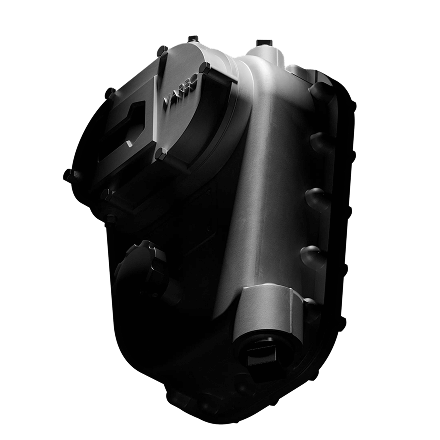
Modulating Low-Pressure Gas Regulator
For biogas engineers, utility-fuel specialists, and burner-train designers, the Shand & Jurs Biogas 97177 Double Port Pressure Regulator delivers steady downstream pressure as demand changes across flares, burners, and fuel-gas equipment at wastewater and landfill sites.
Unlike single-seat regulators that throttle at higher flow and swing pressure when consumption shifts, the 97177 uses opposing balanced seats so outlet pressure stays stable while the valve passes greater capacity at comparable settings.
A large sensing diaphragm responds to actual demand rather than local turbulence, and the regulator can be reconfigured in the field as either a pressure-reducing downstream regulator or a back pressure upstream regulator to suit the application.
Rated for 2 PSIG inlet pressure and up to 20″ W.C. outlet control across 2″–12″ flanged sizes in cast aluminum, the 97177 modulates fuel-gas supply to burners, boilers, heat exchangers, and flare systems without cycling the line.
Opposing seats cancel diaphragm forces, passing higher flow at low pressure while holding control accuracy tighter than single-seat regulators at comparable settings.
Oversized diaphragm responds to true demand changes rather than local turbulence, eliminating pressure oscillation and unstable operation during varying gas production or consumption.
Valve position adjusts smoothly as downstream demand shifts rather than cycling fully open and closed, preventing flame instability and nuisance burner shutdowns.
Configurable in the field as a downstream pressure-reducing regulator or upstream back pressure regulator, matching one body to multiple gas-handling duties on-site.
Spring-loaded setpoint allows precise in-service tuning of operating pressure, supporting commissioning and rebalancing without removing the regulator from the gas train.
Corrosion-resistant cast aluminum with accessible internal assembly enables cleaning and rebuild in wet gas and condensate environments typical of biogas duty.
Downstream Pressure Regulator (configurable as back pressure regulator)
±3″ W.C. of factory set, up to 20″ W.C. maximum
2 PSIG
2″ – 12″
150 lb. ANSI FF Flange
Cast Aluminum
Aluminum / Stainless (size dependent)
Reinforced Elastomer
Stainless Steel
If you have questions not covered here, please contact the Cognesense support team for assistance.
Contact Us ↵
Opposing balanced seats cancel diaphragm forces, so the 97177 passes greater flow at the same low setpoint without pressure droop. Single-seat regulators begin throttling sooner and swing outlet pressure as demand shifts.
Yes. The valve can be configured as a downstream pressure-reducing regulator to maintain constant outlet pressure, or as a backpressure upstream regulator to maintain a controlled feed pressure. Configuration is selected to match the application.
Maximum inlet pressure is 2 PSIG. Typical control range is ±3″ W.C. of the factory set point with a maximum of 20″ W.C. outlet. Line sizes are 2″–12″ with 150 lb. ANSI FF flange connections.
Yes. The cast aluminum body, stainless steel spring, and reinforced-elastomer diaphragm handle wet gas and condensate typical of digester and landfill service. The internal assembly is serviceable, so fouling can be cleaned in the field.
No. The regulator is self-contained — the large sensing diaphragm responds directly to downstream demand and modulates the valve continuously. No external transmitter, controller, or power supply is required for steady pressure control.
Continuous modulation prevents cycling between fully open and closed, which keeps burners and flares stable, reduces blower energy consumption, and avoids the fuel waste and nuisance shutdowns that come with oscillating supply pressure.
With over a century of tank-safety heritage inside Cognesense, the Shand & Jurs Biogas 97177 Double Port Pressure Regulator is chosen where low-pressure gas trains must deliver steady pressure across changing demand. Its balanced opposing seats pass higher capacity than single-seat regulators, its large diaphragm responds to real demand rather than local turbulence, and its continuous modulation keeps burners and flares stable. Used as primary fuel-gas control, it is trusted wherever you need to measure, monitor, and protect what matters most.