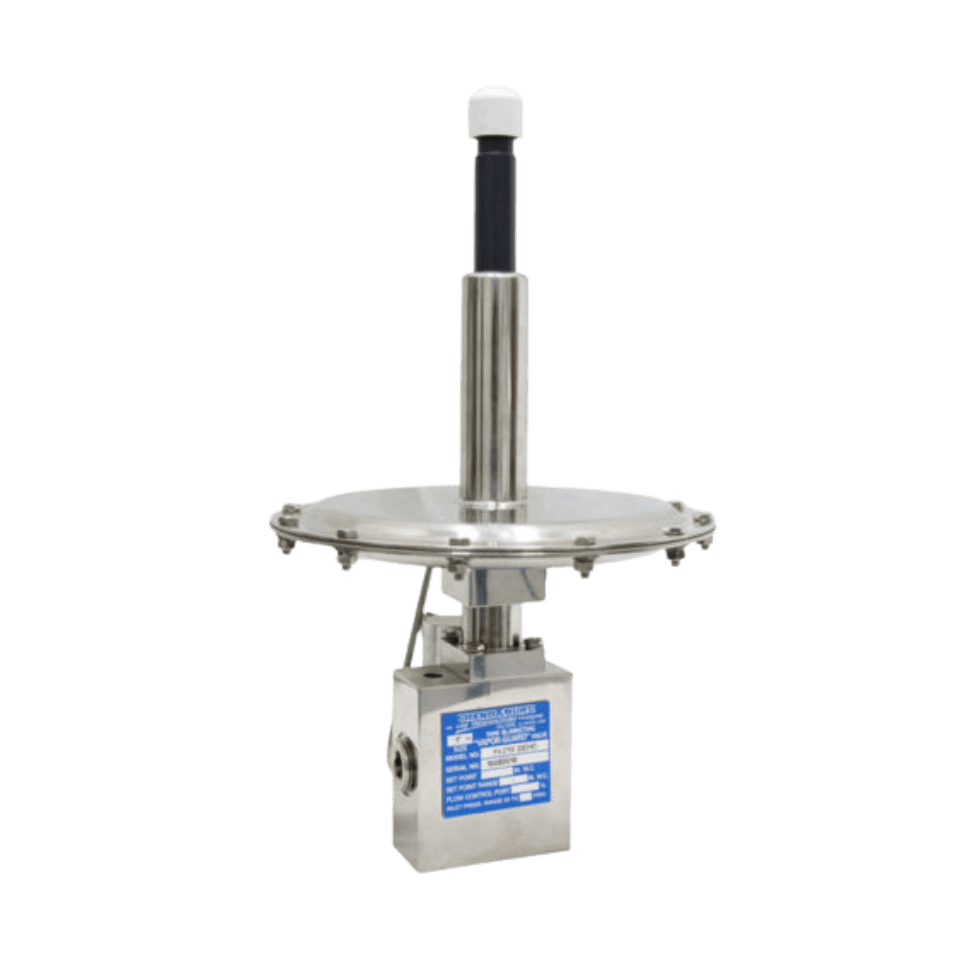
Modulating Tank Blanketing Valve
For chemical terminal operators, blanketing-system engineers, and product-integrity specialists, the Shand & Jurs 94270 Vapor Guard Tank Blanketing Valve maintains a controlled inert gas blanket in pressure-tight storage tanks, keeping air, moisture, and vapor contamination out during pump-out and thermal contraction.
Unlike on/off blanketing regulators that cycle fully open and closed around a setpoint, the 94270 uses a balanced piston main valve and pilot diaphragm to modulate gas flow in proportion to real tank demand, so pressure stays inside a tight band even as plant nitrogen header pressure fluctuates.
Installed directly on the tank, the valve replaces multi-component blanketing arrangements with a single modulating device, reducing piping connections and leak paths while consolidating sensing and flow control. A field test connection allows setpoint verification on-tank without taking the valve out of service.
System cleanliness is maintained through upstream filtration and material selection, supporting consistent pilot performance in real field conditions on nitrogen blanketing, oxidation-sensitive products, hygroscopic liquids, pump-out duty, and thermal-contraction protection for pressure-tight tanks.
Maintains a constant set pressure independent of inlet supply pressure variation, so plant nitrogen header swings do not shift the tank setpoint.
Proportionally meters blanketing gas rather than cycling fully open and closed, eliminating regulator chatter and pressure overshoot on demand changes.
Combines sensing and flow control into one tank-mounted device, reducing piping connections, leak paths, and installed footprint versus multi-component arrangements.
Allows pressure selection from 0.5 in. W.C. to 15 psig, matching the blanketing band to the specific product and tank design.
Port sizing from 10–200 percent matches gas supply capacity to the calculated in-breathing demand sized per API 2000.
Set-point verification can be performed on-tank without removing the valve from service, supporting routine audits and commissioning checks.
Modulating tank blanketing regulator
0.5 in. W.C. – 15 psig
1/2″: 20 psig. 1″ and 2″: 30 psig
1/2″ and 1″: 200 psig (100% flow port). 2″: 100 psig (100% flow port)
Modulating blanketing regulator
Direct tank mounting
Threaded or flanged
1/2″, 1″, and 2″
−40°F (−40°C) to 250°F (121°C) (NBR and EPDM); +20°F (−7°C) to 350°F (177°C) (FKM and FFKM)
304 or 316 Stainless Steel
316 Stainless Steel
EPDM, FEP, FKM, or NBR
Painted Carbon Steel or 316 Stainless Steel
EPDM, FKM, FFKM, or NBR
Stainless steel
Stainless steel
In-breathing demand sized per API 2000
External sense (standard), dip-tube external sense for vertical remote sensing, internal sense on 1/2″ vertical model; flow control ports 10–200 percent; inlet and pilot filters; check valve accessory; pressure gauges; diaphragm material selection
If you have questions not covered here, please contact the Cognesense support team for assistance.
Contact Us ↵
An on/off regulator opens fully when tank pressure falls below setpoint and closes fully once it is restored, causing regulator chatter and pressure overshoot on each cycle. The 94270 uses a balanced piston main valve and pilot diaphragm to meter blanketing gas proportionally, matching flow to actual tank demand. This keeps pressure inside a tight band, reduces nitrogen consumption, and protects seals and internals from cycling wear.
No. The balanced piston design holds the set pressure virtually unchanged across the rated inlet supply range. That means fluctuations in the plant nitrogen header do not translate into changes at the tank, which is important on sites where several tanks share a common supply and drawdown events move the header pressure around.
The 94270 includes a field test connection that lets operators verify the set point on-tank, without removing the valve from service. This supports routine audits, turnaround inspections, and recommissioning checks without interrupting blanketing protection on the stored product.
Capacity is sized per API 2000 in-breathing demand — combining liquid pump-out rate with thermal-contraction load — to determine the required gas flow. Flow control ports between 10 and 200 percent are available so the same base valve can be matched to the calculated demand rather than oversized by default.
Body and seat are 304 or 316 stainless steel; trim is 316 stainless steel. Diaphragm options include EPDM, FEP, FKM, and NBR, with seal options in EPDM, FKM, FFKM, and NBR. Temperature range extends from −40°F (−40°C) on NBR and EPDM up to 350°F (177°C) on FKM and FFKM, covering most chemical and petrochemical blanketing duties.
Pilot and piston performance depend on clean, dry gas. Particulate or condensate carried in the plant nitrogen header can disturb modulation and shorten seal life. Inlet filters and pilot filters are available options, and system cleanliness is maintained through upstream filtration and material selection rather than relying on factory cleaning specifications.
The 94270 adds inert gas to protect the vapor space. The Shand & Jurs 94261 Vapor Recovery Regulator is the correct selection when the goal is the opposite — routing tank breathing vapors into a recovery header rather than venting to atmosphere. The two products are complementary and often paired on the same tank for closed-loop pressure management.
With over a century of tank-safety heritage inside Cognesense, the Shand & Jurs 94270 Vapor Guard Tank Blanketing Valve is chosen where a nitrogen blanket needs to hold pressure in a tight band, not just switch on and off. Its balanced piston main valve, modulating pilot, and single-device installation deliver stable vapor-space protection across fluctuating supply pressures, shifting product volumes, and thermal cycles. For pressure-tight chemical, solvent, and specialty-fluid storage, it is trusted wherever you need to measure, monitor, and protect what matters most.