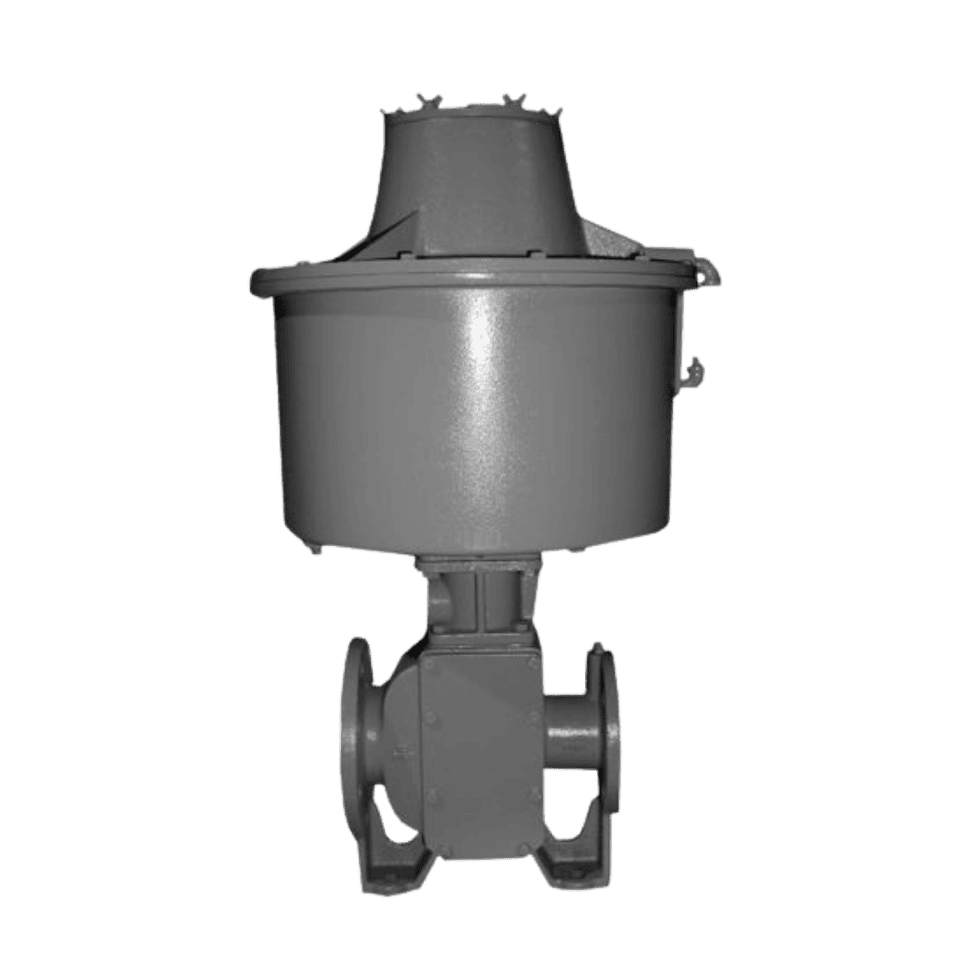
For terminal operators, emissions engineers, and closed-vent-system designers, the Shand & Jurs 94261 Vapor Recovery Regulator controls tank pressure before atmospheric relief devices engage, routing routine breathing vapors into a recovery header instead of releasing them through conservation vents.
Unlike relying on conservation vents to cycle continuously as tanks breathe, the 94261 holds the vapor space within approximately ±0.1 in. W.C. across a typical 0.1–2 in. W.C. range, so pallets only open on genuine excursions rather than on every thermal or pump-in event.
A weight-balanced float sensing assembly provides fully mechanical, bidirectional regulation: the valve opens to the recovery header when pressure rises above setpoint and admits gas when vacuum develops. Calibrated weights tune the setpoint in the field, without utilities or instrumentation.
Stabilizing the vapor space before relief activation shifts routine breathing away from atmospheric discharge, cutting continuous emissions, preserving stored product, and converting conservation vents into true emergency-only devices with longer service intervals.
Maintains a tight control band of approximately ±0.1 in. W.C., preventing oscillation near relief setpoints and eliminating nuisance cycling.
Routes vapor to the recovery header on pressure rise and admits gas under vacuum, stabilizing the tank vapor space in both directions.
Operates without electricity, air supply, or control instrumentation, giving predictable regulation in remote or utility-limited storage installations.
Allows precise field tuning of the pressure control range by swapping calibrated weights, with no actuator, positioner, or controller.
Regulates tank pressure ahead of the conservation vent so pallets only open on genuine excursions, extending rebuild intervals.
Reduced moving-part design minimizes mechanical wear and sticking in low-pressure service, supporting long intervals between inspections.
Vapor recovery regulator (upstream of conservation vent)
0.1 – 2 in. W.C.
Approximately ±0.1 in. W.C.
Bidirectional pressure and vacuum
Fully self-actuated (no utilities or instrumentation)
Weight-balanced float
Calibrated weights
Upstream of the conservation vent
Hydrocarbon and compatible vapors
Steel
Weighted mechanical float
Steel internal linkage
Service-compatible elastomer
Calibrated steel weights
Stainless steel
Alternate weight ranges; corrosion-resistant materials; multiple flange connections; low-temperature seals; protective coatings; service configuration selection (pressure, vacuum, or both)
If you have questions not covered here, please contact the Cognesense support team for assistance.
Contact Us ↵
A conservation vent opens at a fixed setpoint and is designed as an emergency pressure/vacuum relief device. The 94261 sits upstream of the vent and regulates tank pressure across a controlled band of roughly ±0.1 in. W.C., routing routine breathing vapors to a recovery header rather than discharging them. The conservation vent remains in place as a true emergency backup that only opens on genuine excursions.
No. Operation is fully self-actuated. A weight-balanced float senses tank pressure and drives a bidirectional valve directly through calibrated weights, with no electricity, air supply, positioner, or controller. This supports use in remote terminals, unclassified areas, and sites with limited utility infrastructure.
Setpoint is set by selecting calibrated weights on the float sensing assembly. Alternate weight ranges are available so the same base regulator can be tuned across the 0.1 to 2 in. W.C. control band without field-fabricating linkages or recalibrating actuators.
The regulator is installed upstream of the conservation vent, between the tank vapor space and the vapor recovery header. This position lets the device control routine breathing into the recovery system while the existing conservation vent remains in place for emergency relief.
Yes, with appropriate material selection. Corrosion-resistant material options and low-temperature seals are available to match chemical, biofuel, and wastewater-digester vapor environments. Service-compatible elastomer seals, protective coatings, and multiple flange connections support integration into typical vapor-recovery piping layouts.
Maintaining tank pressure within a narrow, predictable band prevents repetitive conservation-vent openings caused by small thermal and pump-induced pressure swings. That stability reduces pallet wear, lengthens vent inspection and rebuild intervals, lowers continuous emissions, and simplifies environmental reporting by keeping discharges out of the routine-operation path.
The 94261 routes tank vapors to a recovery header. The Shand & Jurs 94270 Tank Blanketing Valve is the correct selection when the goal is inert-gas make-up service rather than vapor routing — for example, maintaining a nitrogen blanket over a moisture- or oxidation-sensitive product. The two products are complementary and commonly paired in closed-vent storage systems.
With over a century of tank-safety heritage inside Cognesense, the Shand & Jurs 94261 Vapor Recovery Regulator is chosen when routine breathing belongs in a recovery header rather than at atmosphere. Its weight-balanced float sensing and fully mechanical bidirectional valve hold tank pressure within a tight control band, extending conservation-vent life and cutting continuous emissions on terminal, chemical, biofuel, and digester storage alike. For closed-vent systems, it is trusted wherever you need to measure, monitor, and protect what matters most.